TL;DR:
- Many properties in southern England face increasing flood risks due to aging drainage systems and changing rainfall patterns. Upgrading drainage with sustainable solutions enhances flood resilience, property value, and environmental impact while requiring ongoing maintenance for optimal performance. Proper documentation and proactive management are essential for legal compliance, insurance benefits, and long-term flood protection.
Thousands of properties across southern England face growing flood and water damage risks each year, yet most homeowners treat their drainage systems as an afterthought until something goes seriously wrong. Drainage upgrades are not simply an expensive form of maintenance. They are a strategic investment that strengthens flood resilience, supports planning compliance, improves your property’s appeal to buyers and insurers, and protects the long-term value of what is likely your biggest financial asset. This article explains why the case for upgrading has never been stronger, and how to approach it intelligently.
Table of Contents
- Understanding modern drainage challenges in southern UK
- How drainage upgrades reduce risk and boost property value
- Key drainage solutions: SuDS, property-level measures, and beyond
- The crucial role of maintenance in drainage performance
- Legal and planning incentives for upgrading drainage
- What most homeowners miss about drainage upgrades
- Expert drainage support for southern UK homes
- Frequently asked questions
Key Takeaways
| Point | Details |
|---|---|
| Upgrades cut flood risk | Investing in drainage upgrades is among the most effective ways to reduce flooding on your property. |
| Boosts property value | Modern drainage solutions make homes more attractive to buyers and insurers, supporting market value. |
| Maintenance is essential | Even advanced drainage systems need planned, regular attention to keep working optimally. |
| Supports legal compliance | Many upgrades align with UK planning requirements, reducing future legal or insurance issues. |
Understanding modern drainage challenges in southern UK
Southern England has always faced wetter winters than many people expect, but the pattern of rainfall has shifted considerably over the past two decades. Storms that once arrived gradually now deliver intense bursts of surface water in very short periods. Traditional drainage systems, many of which were installed decades ago, were simply not designed for this kind of pressure.
The challenge is not just about rainfall volume. Increased development across towns in Surrey, Hampshire, Kent, and Sussex has replaced enormous areas of natural ground with hard surfaces such as tarmac, concrete, and paving. When rain falls on these surfaces, it cannot soak away naturally. Instead, it rushes into street drains, garden gullies, and combined sewer systems that are already working at capacity.
The consequences of this mismatch are serious and wide-ranging:
- Surface water flooding affects gardens, driveways, and ground-floor rooms during heavy rain
- Sewer surcharge occurs when overloaded drains force foul water back up through toilets and sinks
- Property damage from repeated flooding leads to damp, structural cracking, and loss of value
- Higher insurance premiums or even refusal of cover for properties in recognised flood zones
- Environmental impact through pollution running off hard surfaces into local waterways
The good news is that surface water drainage threats are well understood and there are proven solutions. The Government has made its position clear: sustainable drainage systems (SuDS) are a government-prioritised way to reduce flood risk and protect water quality while supporting biodiversity. That framing matters enormously. It positions drainage upgrades not as optional extras but as genuine risk-reduction infrastructure with recognised national standards behind them.
“Ageing systems combined with increasing urbanisation and changing rainfall patterns create a perfect storm of drainage failure. Waiting for a problem to appear is no longer a sensible strategy.”
The need for drainage upgrades is now clearly backed by both practical experience and government policy, making it easier to justify the investment with confidence.
How drainage upgrades reduce risk and boost property value
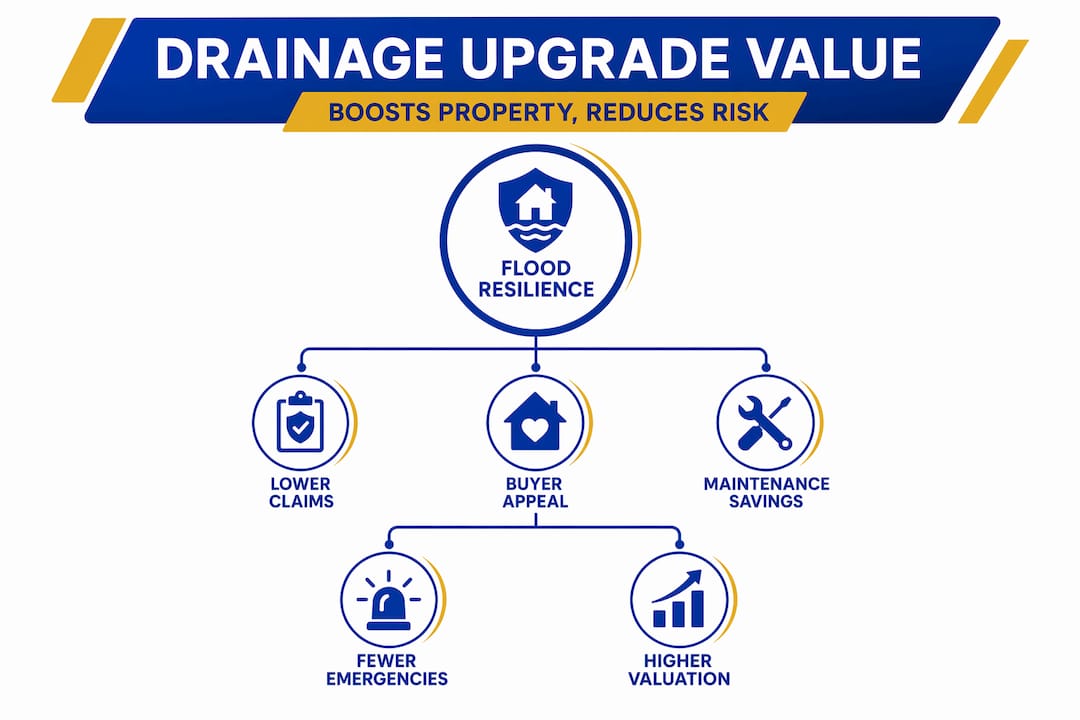
One of the most common misconceptions is that drainage upgrades are purely about preventing flooding. In reality, the benefits spread across several financial and practical areas that matter deeply to homeowners and property managers.
Flood resilience and reduced maintenance costs
A well-upgraded drainage system handles rainfall more efficiently, reducing the likelihood of emergency call-outs, structural repairs, and costly clean-ups. Systems that incorporate SuDS features slow down water flow, spread the load across the network, and reduce peak discharge into main sewers. This directly lowers pressure on ageing infrastructure and, as whole-life cost of upgrades analysis shows, the long-term savings comfortably outweigh the upfront cost in most cases.
| Feature | Short-term cost | Long-term benefit |
|---|---|---|
| Permeable paving | Moderate installation | Reduced surface flooding, lower maintenance |
| Rain garden | Low to moderate | Natural filtration, biodiversity boost |
| Soakaway renewal | Moderate | Improved groundwater management |
| Green roof | Higher installation | Reduced runoff, insulation benefit |
| CCTV drainage survey | Low | Early detection of hidden faults |
Property value and buyer appeal
Flood resilience is now a measurable factor in property valuations across southern England. Estate agents and surveyors in areas like the Thames Valley and coastal Hampshire report that buyers actively research flood risk data before making offers. A property with documented drainage upgrades, a SuDS-compliant system, or a clear flood risk mitigation plan commands greater confidence and, in competitive markets, a stronger price.
Insurance advantages
Insurers are paying close attention to flood risk, and the picture is changing rapidly. Properties in high-risk postcodes face significantly higher premiums or exclusions for flood-related damage. However, when you can demonstrate proactive investment in drainage resilience, some insurers will revise their risk assessment favourably. The FloodReady action plan links SuDS directly to reduced sewer overflow pressure and whole-life cost justification, reinforcing the economic case for upgrades.
Key figure: Properties in flood-affected areas can see values fall by 10% or more after a flooding event, while those with documented resilience measures maintain stronger valuations over time.
Pro Tip: Keep a written record of every drainage upgrade, inspection, and maintenance visit. This documentation is invaluable when speaking with insurers, solicitors, or planning authorities.
The benefits of upgrading include:
- Lower risk of emergency drainage failures and costly reactive repairs
- Stronger position when negotiating property insurance terms
- Greater buyer confidence and improved resale appeal
- Reduced contribution to local sewer overload and environmental runoff
Key drainage solutions: SuDS, property-level measures, and beyond
Understanding which upgrade is right for your property depends on the type of flooding threat you face and the specific characteristics of your site. There is no single answer, but there is a clear framework for working it out.
Sustainable drainage systems (SuDS)
SuDS is the umbrella term for drainage designs that mimic natural water processes. Rather than channelling all rainwater directly into pipes and sewers, SuDS slow, store, and filter water closer to where it falls. They include features such as swales (shallow grass channels), ponds, wetlands, and permeable surfaces.
Property-level measures
These are changes you can make at or around your home without large-scale infrastructure work. Property-level actions including permeable surfaces, rain gardens, and rainwater harvesting are specifically recommended as part of flood resilience strategy to lessen surface runoff and reduce the load on public sewers.
| Solution | Best for | Typical site |
|---|---|---|
| Permeable paving | High surface runoff | Driveways, car parks, paths |
| Rain garden | Mild to moderate flooding | Gardens with clay or slow-draining soil |
| Green roof | Roof runoff reduction | Flat or low-pitch roofs |
| Rainwater harvesting | Supply reuse and runoff control | Most residential properties |
| Soakaway or infiltration crate | Groundwater management | Properties with suitable subsoil |
Matching solution to threat type
A phased approach works best for most homeowners:
- Identify the primary source of flooding (surface water, sewer surcharge, or groundwater)
- Assess site conditions including soil permeability, slope, and existing drainage routes
- Choose the most appropriate solution or combination of measures
- Obtain any necessary planning permission, particularly for larger works
- Commission installation by a qualified drainage professional with relevant experience
Exploring the full range of types of drainage upgrades and choosing drainage solutions will help you narrow down the most effective options for your specific property before you commit to any works.
“The most effective approach combines more than one measure. A permeable driveway paired with a small rain garden at the boundary can dramatically reduce the surface water reaching your nearest sewer.”
The crucial role of maintenance in drainage performance
Here is where many property owners make a costly mistake. They invest in drainage upgrades and then assume the job is done. It is not.
Even the most well-designed SuDS feature or permeable surface will lose its effectiveness without regular maintenance. Poor or unplanned SuDS maintenance can cause blockage and loss of capacity, ultimately increasing flood risk rather than reducing it. That is the uncomfortable truth that does not always come up during the sales process.
The most common maintenance failures include:
- Silt accumulation in soakaways, swales, and filter drains, reducing infiltration capacity
- Blocked inlets and outlets caused by leaf litter, debris, or root ingress
- Overgrown vegetation restricting flow through channels and around surface features
- Compaction of permeable surfaces from vehicle weight, reducing water penetration over time
- Neglected inspection chambers that allow tree root intrusion to go undetected
A sensible maintenance schedule for most residential drainage systems looks like this:
- Visual inspection of all visible drainage features every three months
- Clearing of debris from inlets, outlets, and surface channels
- Professional CCTV drain survey annually or following any flooding event
- Silt removal from soakaways and filter drains every two to three years
- Vegetation management twice yearly for rain gardens, swales, and green roofs
Pro Tip: Do not wait for a blockage to arrange a professional inspection. Annual drainage best practices surveys catch problems before they become emergencies, saving significant money in the long run.
The role of drainage maintenance in preventing floods is often underestimated until the first serious failure. Modern technology, including remote monitoring sensors and innovative drainage maintenance tools, now makes it easier than ever to spot developing problems early without waiting for visible symptoms.
Legal and planning incentives for upgrading drainage
The regulatory environment in England is shifting noticeably in favour of proactive drainage management. This matters practically for homeowners planning extensions, new builds, or significant property changes, but it also has implications for existing properties in flood-risk zones.
- Flood risk assessments (FRA) are required for planning applications in flood zones 2 and 3, as well as for certain developments in flood zone 1 where specific conditions apply. A well-prepared FRA demonstrates that your drainage plans meet national standards.
- SuDS strategies are increasingly expected by local planning authorities as a condition of approval for new development and major alterations. Properties that already have compliant systems in place are better positioned to gain approval quickly.
- Documentation of upgrades can support insurance negotiations, planning submissions, and disputes with neighbouring parties over drainage responsibility.
- Future-proofing your position means that as regulations tighten and climate impacts intensify, properties with documented resilience measures will face fewer obstacles.
“In England, the planning process can require a flood risk assessment and, where relevant, a sustainable drainage strategy. Proactive documentation of your drainage arrangements puts you ahead of regulatory requirements rather than scrambling to meet them.”
Property managers overseeing multiple sites have particular reason to invest in documentation. Insurance renewals, tenant safety obligations, and lender requirements all increasingly reference flood risk. Having a clear, up-to-date record of drainage systems and maintenance history is no longer optional for professionally managed properties.
What most homeowners miss about drainage upgrades
After working with properties across southern England, we have seen a pattern that repeats itself more often than it should. Homeowners spend money on a drainage upgrade, receive assurances that the problem is solved, and then do nothing further for several years. When flooding returns, as it sometimes does, the disappointment is real and understandable.
But here is the thing: the upgrade did not fail. The maintenance did.
SuDS and property-level measures only deliver flood resilience benefits when designed for the site’s conditions and then maintained. A soakaway that silts up within three years of installation provides no benefit in the fourth year when the next big storm arrives. A rain garden with overgrown inlets becomes an ornamental feature rather than a functional drainage tool.
There is also a widespread misunderstanding about what drainage upgrades actually promise. They do not eliminate flood risk. They reduce it. Government guidance frames drainage upgrades as part of a broader resilience approach covering resistance, recoverability, and reduction. A property that has invested in all three areas is significantly better placed than one that has done nothing, but no system in the world can guarantee zero flooding under all possible conditions.
The honest message is this: drainage upgrades are an ongoing, actively managed process. The investment is not a one-time transaction. It is a commitment to regular inspection, seasonal maintenance, and professional support when the system is challenged by unusual weather. Those who understand this get the results they paid for. Those who treat it as a set-and-forget solution are sometimes disappointed. Thinking about upgrading for resilience in this way changes everything about how you plan and budget for it.
Expert drainage support for southern UK homes
If this guide has helped clarify the value of drainage upgrades, the next step is getting a professional assessment of your current system before committing to any works. Most problems we encounter could have been caught earlier with straightforward inspection.
At Local Services Drainage, we work with homeowners and property managers across southern England to assess, upgrade, and maintain drainage systems that genuinely perform when they are needed most. Starting with a professional CCTV drain survey gives you an accurate picture of what is happening inside your pipes and soakaways without any guesswork. From there, our team can advise on the most cost-effective route to a compliant, resilient drainage system. If you are ready to take informed action, learn more about upgrading your drainage and request a survey today.
Frequently asked questions
What are the first signs my drainage system needs upgrading?
Frequent surface flooding, slow-draining water, or unpleasant smells around gullies and inspection chambers are strong indicators that your system needs attention. These symptoms often point to capacity problems or blockages that, if left untreated, increase the risk of system failure.
Does upgrading drainage always stop flooding completely?
No. Upgrades significantly reduce flood risk but cannot guarantee zero flooding under all conditions. Government guidance frames drainage improvements as part of a broader resilience approach combining resistance, reduction, and recoverability rather than a single solution.
Are drainage upgrades required by law in the UK?
Not universally, but many developments must include a flood risk assessment and may require SuDS as a planning condition. The planning process in England increasingly mandates sustainable drainage strategies for new builds and significant alterations in flood-risk areas.
How does SuDS benefit the environment?
SuDS reduce flood risk and limit water pollution by slowing runoff and filtering it naturally. National standards for SuDS also recognise their role in supporting biodiversity and local amenity by mimicking natural water cycles rather than channelling water directly into drains.
How often should I have my drainage system inspected after upgrading?
At least annually, and immediately after any significant flooding event. Regular inspections are essential because poor maintenance can cause blockage and capacity loss, reversing the resilience benefits your upgrade was designed to deliver.