
TL;DR:
- Proper property drainage is essential to prevent costly water damage and structural issues in UK homes. Following a detailed checklist, using the right tools, and understanding local soil conditions help homeowners identify and address drainage problems early. Professional intervention and site-specific solutions ensure long-term effectiveness and safeguard property value against weather-induced stresses.
Water damage creeping into your home is one of the most stressful and expensive surprises a UK homeowner can face. A single blocked drain left unattended can escalate from a minor inconvenience into a flooded garden, a damp cellar, or worse, cracked foundations that cost thousands to repair. The good news is that most drainage problems are entirely preventable with a structured approach. This guide gives you a practical, step-by-step property drainage checklist tailored to UK homes, particularly those in southern regions where soil conditions and rainfall patterns create specific challenges worth understanding.
Table of Contents
- Why effective drainage is vital for UK homes
- What you need before starting your drainage checks
- Step-by-step property drainage checklist
- How to spot and resolve common drainage issues
- Ongoing maintenance: best practices for long-term drainage performance
- A fresh perspective: most checklists overlook your local soil and regulations
- Need expert drainage help? Get reliable support
- Frequently asked questions
Key Takeaways
| Point | Details |
|---|---|
| Prevention saves money | Regular drainage checks stop small issues becoming expensive repairs. |
| Tailored approach matters | Effective drainage systems depend on local soil and guidance like BRE Digest 365. |
| Know when to get help | Specialists are vital for persistent or structural drainage problems. |
| Records make future checks easy | Keep notes of inspections and rainfall to support future maintenance and insurance. |
Why effective drainage is vital for UK homes
Poor drainage is not just an inconvenience. It quietly causes long-term structural damage that most homeowners only notice once it is far too late. Across the UK, property drainage issues range from persistent damp and mould growth inside walls to subsidence caused by waterlogged soil undermining foundations. In southern England, the combination of clay-heavy soils and periodic intense rainfall creates the perfect conditions for surface water to pool and seep where it should not.
“Homes with neglected drainage systems are significantly more vulnerable to structural movement, particularly in areas with expansive clay soils common across southern counties.”
Poor drainage leads to flooding, property damage, and a chain of consequences that are far costlier than any routine maintenance programme. Research from the Association of British Insurers indicates that escape-of-water claims are among the most frequent and expensive for UK homeowners, often stemming from issues that began with an overlooked blocked gully or a failed soakaway.
The core benefits of following a drainage checklist include:
- Peace of mind knowing your property can handle heavy rainfall
- Protected property value since visible drainage problems deter buyers
- Lower repair bills by catching small issues before they become structural
- Reduced mould and damp risk inside your home
- Faster insurance claims when you have a documented maintenance history
Understanding identifying drainage issues early is the most effective way to protect your investment. A checklist turns what could be a vague worry into a clear, actionable routine.
What you need before starting your drainage checks
Once you know the risks, the next step is making sure you are properly prepared before you go anywhere near a drain cover. Rushing in without the right tools or information wastes time and can even cause injury.
Here is a quick reference table of what you will need:
| Item | Purpose | Priority |
|---|---|---|
| Torch (head-mounted) | Inspect dark gullies and underground chambers | Essential |
| Protective gloves | Handle drain covers and debris safely | Essential |
| Drain rods | Clear minor blockages in accessible pipes | Recommended |
| Property plans or drainage maps | Locate all drainage runs on your land | Very useful |
| Previous CCTV survey reports | Understand existing vulnerabilities | Useful |
| Camera or smartphone | Document condition of drain covers and gullies | Recommended |
| Bucket and stiff brush | Clean gully pots and debris traps | Essential |
| BRE Digest 365 reference | Guide soakaway sizing and infiltration | Essential for soakaways |
Your local authority may hold records of drainage infrastructure if you cannot find your own property plans. It is worth requesting these before you start, particularly if your home was built before 1980 and records may be incomplete.
A proper drainage inspection guide will also tell you where to focus your attention based on the age and construction type of your property. Older homes often have clay pipe systems that are more prone to root ingress and joint failure than modern plastic alternatives.
Pro Tip: If your property has a soakaway, you should carry out an infiltration test before assuming it is working correctly. Infiltration testing and trial pits for soakaways are strongly advised, with recognised guidance from sources like BRE Digest 365 used to assess whether your system is fit for purpose. Simply looking at the soakaway surface tells you very little about its actual performance under load.
Use your drainage maintenance checklist alongside these preparations to keep everything organised and ensure nothing is missed during your inspection.
Step-by-step property drainage checklist
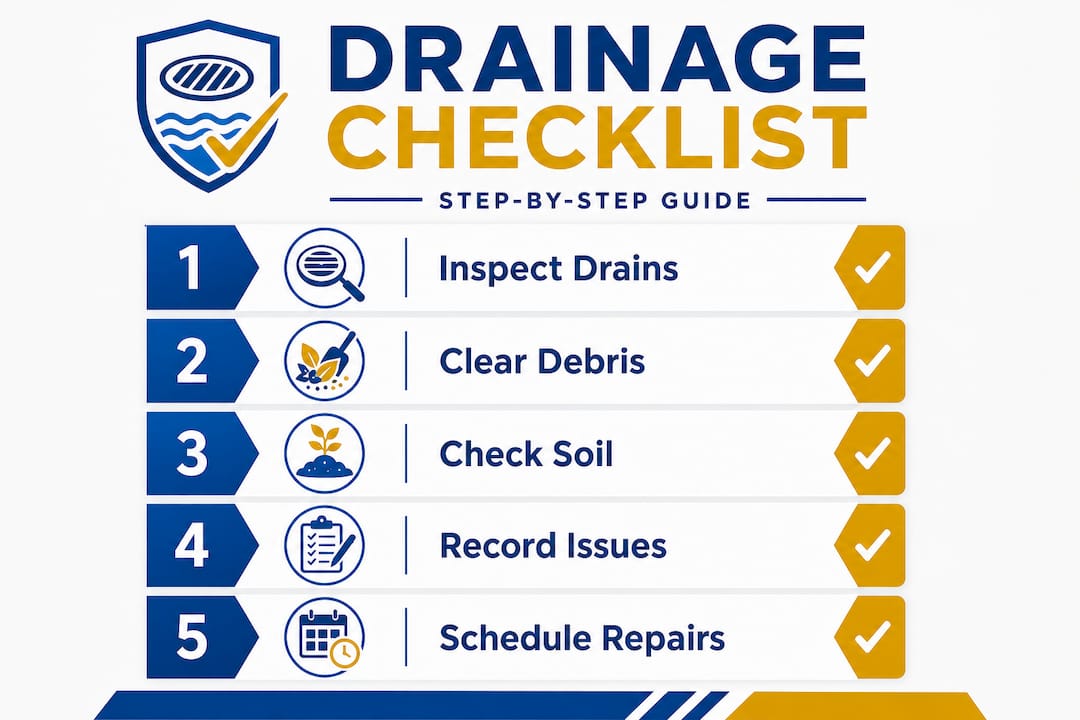
With your tools gathered and paperwork to hand, work through the following checklist methodically. Do not skip steps, even if a particular drain looks clean on the surface.
-
Locate all drainage points on your property. Walk the full perimeter and identify every gully, downpipe outlet, channel drain, inspection chamber, and soakaway. Mark them on a simple hand-drawn plan if you do not have formal drawings.
-
Remove and inspect all drain covers. Look for cracks, rust, or damage that could allow debris to enter. A damaged cover is often a sign that the chamber below has also been compromised.
-
Clear visible debris from gullies and grates. Leaves, silt, and compacted dirt block gully pots fast, especially in autumn. Remove debris by hand (with gloves) and scrub the pot clean with a stiff brush.
-
Run a water flow test. Pour a bucket of water into each gully or downpipe outlet and watch how quickly it drains. Slow drainage almost always means a partial blockage somewhere downstream.
-
Check downpipes are securely fixed and unobstructed. Birds and squirrels frequently nest in downpipes during spring. A blocked downpipe pushes water behind the fascia board and into the wall cavity.
-
Inspect visible pipe runs for damage. Look for sagging sections, root intrusion at joints, or signs of ground movement such as pipes that are no longer level.
-
Assess the soakaway area. If the ground above your soakaway remains waterlogged hours after rainfall, the system may be at capacity or failing. Drainage systems must match local soil permeability to be effective, which is why a soakaway that worked perfectly in one property may fail entirely in another with different ground conditions.
-
Check inspection chamber interiors. Remove the lid safely and look for visible blockages, signs of root ingress, or water levels that are abnormally high.
-
Note any unusual smells. A persistent sewage or eggy smell near a drain often signals a partial blockage or a dried-out trap allowing gases to escape.
-
Document everything with photographs. Date-stamped photos create a valuable maintenance record and support any future insurance claims or property sale queries.
Here is a comparison of quick seasonal checks versus your deeper annual inspection:
| Check type | Frequency | Time required | Tools needed |
|---|---|---|---|
| Seasonal surface check | Every 3 months | 30 to 60 minutes | Torch, gloves, bucket |
| Full annual inspection | Once per year | 2 to 4 hours | All tools plus records |
| Post-storm inspection | After major rainfall | 20 to 30 minutes | Torch, gloves |
| Soakaway infiltration test | Every 3 to 5 years | Half day | Trial pit equipment or specialist |
A comprehensive surface water drainage guide can help you understand how surface and foul water systems interact on your specific property type, which is particularly important if you have a combined system.
Pro Tip: Follow a drain maintenance schedule that adjusts for your property’s surroundings. A garden heavily planted with trees will need gully clearance every autumn without exception. A more open property may manage with two checks per year.
How to spot and resolve common drainage issues
After working through the checklist, you may discover something that needs attention. Here is how to recognise problems and decide on the right response.
Early warning signs to watch for:
- Standing water on lawns, driveways, or patios more than an hour after rainfall stops
- Gurgling sounds from toilets or sinks when water drains elsewhere in the house
- Slow-draining sinks, baths, or gullies that were not slow before
- Damp patches appearing on internal walls at ground level
- A persistent foul smell near drain covers or inspection chambers
- Cracks appearing in paved areas adjacent to drainage runs
Simple DIY fixes for minor issues:
For a blocked gully pot, remove the debris by hand and flush with hot water from a hose. For a downpipe blocked near the top, a set of drain rods with a plunger attachment will usually shift the obstruction. Clearing a blocked common drainage repair at gully level is genuinely something most homeowners can do in under thirty minutes.
“Knowing when to stop and call a professional is just as important as knowing how to start. Underground pipe failures or soakaway collapse require specialist equipment to diagnose and repair safely.”
For anything involving underground pipes, collapsed chambers, or a soakaway that has completely failed, you should contact a certified drainage specialist. Drainage maintenance and flooding prevention becomes particularly important when you are dealing with a systemic failure rather than surface debris.
Pro Tip: If you are making any changes to drainage infrastructure on your property, including adding a new driveway or extending a soakaway, infiltration testing and recognised guidance are required. Skipping this step can result in a system that creates more flooding than it prevents and could leave you in breach of planning conditions.
Ongoing maintenance: best practices for long-term drainage performance
Prevention is a far better strategy than emergency repairs. Southern UK homes in particular benefit from a consistent maintenance routine because clay soils swell and shrink dramatically with the seasons, putting constant stress on older pipe joints and chamber walls.
Best practices to keep your drainage performing year-round:
- Schedule a professional CCTV survey every three to five years. Camera surveys reveal root ingress, pipe collapse, and joint failure that no surface inspection can detect.
- Keep a drainage log. Record every inspection date, what you found, and what action you took. This is invaluable when selling your property or making an insurance claim.
- Clear gullies every autumn without fail. Autumn leaf fall is the single biggest contributor to blocked surface drains across southern England.
- Note rainfall patterns over time. If your garden floods every time more than 20mm of rain falls in a day, that threshold tells you a great deal about your soakaway capacity.
- Check downpipe connections seasonally. The joints between downpipes and underground drainage are a notorious weak point and are worth inspecting every spring and autumn.
- Avoid pouring fat or cooking oil down sinks. Fatbergs are not just a problem for municipal sewers. They build up in private drainage runs just as readily and are expensive to clear.
Systems should match local soil permeability and should always be designed or assessed with reference to recognised guidance such as BRE Digest 365. This matters enormously for southern UK homeowners where chalk, clay, and mixed soils create very different drainage challenges from one street to the next.
Investing in drainage maintenance and flooding prevention as an ongoing habit rather than a reactive scramble after a problem emerges will save you significant money over the lifetime of your property. Your maintenance checklist should become as routine as servicing your boiler.

Pro Tip: Keep a simple spreadsheet noting inspection dates, rainfall events that caused issues, and any work carried out by contractors. Over three to four years, patterns emerge that help you anticipate problems before they happen rather than reacting to them after the fact.
A fresh perspective: most checklists overlook your local soil and regulations
Most drainage checklists you will find online treat every UK property as if it sits on the same ground in the same climate. That is a genuinely dangerous assumption, and it is one that costs homeowners money every year. A checklist designed for a sandy-soiled property in Norfolk will fail spectacularly if applied without adaptation to a clay-heavy garden in Surrey or Hampshire.
The uncomfortable truth is that drainage performance is local. The permeability of your specific soil, the gradient of your land, the size and age of your pipes, and your proximity to local watercourses all determine how your drainage system behaves. Generic advice ignores every one of these variables. Recognised guidance being vital for effective drainage systems is not bureaucratic caution. It reflects the fact that drainage engineering is genuinely site-specific.
Southern UK homeowners would do well to treat BRE Digest 365 not as an optional reference but as the baseline for any decision about soakaways, surface water management, or drainage system changes. The guidance exists because too many systems have been built without proper infiltration testing and subsequently failed.
We have seen, time and again, that homeowners who engage with drainage solutions for local needs get better long-term results than those who follow a one-size-fits-all approach. Adapting your checklist to your soil type, your local rainfall data, and the specific construction of your home is not overcomplicated. It is simply the difference between a system that works and one that gives you trouble every winter.
Need expert drainage help? Get reliable support
Even the most diligent homeowner will eventually encounter a drainage problem that goes beyond what a bucket and a set of drain rods can solve. That is precisely where professional expertise pays for itself.
At Local Services Drainage, we offer fast, reliable support for homeowners across the southern UK. Whether you need guidance on how to unblock a drain yourself or require a full CCTV survey to diagnose an underground fault, our team is equipped to help. Our professional maintenance checklist service gives you a thorough, documented inspection carried out by drainage specialists who understand southern soil conditions. We also use advanced drainage technology including no-dig relining to fix pipe failures with minimal disruption to your garden or driveway. Get in touch today for a quote and take the guesswork out of property drainage.
Frequently asked questions
What is the most common cause of blocked drains in UK homes?
The most common cause is a build-up of debris such as leaves, silt, and household fat blocking pipes and gullies, particularly in autumn and winter when rainfall is highest and fallen leaves accumulate rapidly.
How often should property drainage be checked?
It is good practice to check visible drainage points at least twice a year and after major storms. Regular checks and referencing guidance like BRE Digest 365 are consistently recommended for homeowners who want to stay ahead of problems rather than react to them.
Do I need to hire a professional for drainage issues?
For persistent or severe problems, especially those involving underground systems or soakaways, it is always safest to consult a drainage specialist. Recognised guidance is needed for effective underground drainage systems, and specialists have the diagnostic tools to identify problems a visual inspection simply cannot reveal.
Does soil type affect property drainage?
Yes, soils with low permeability such as clay drain very poorly and require tailored solutions. Always refer to guidance like BRE Digest 365 for best results, as drainage systems must match the specific permeability of your local soil to function correctly and avoid causing more problems than they solve.