TL;DR:
- Regular drainage maintenance prevents costly repairs by identifying problems early and adhering to seasonal schedules.
- Using the correct tools, following routine tasks, and documenting inspections help property owners manage drainage effectively and avoid legal issues.
Blocked drains, flooded gardens, and damp foundations rarely appear without warning. They build slowly, drain by drain, season by season, until a small inconvenience becomes a costly repair. Whether you manage a single home or a portfolio of commercial properties, a reliable guide to drainage maintenance can save you thousands of pounds and the kind of stress that ruins a perfectly good weekend. This guide walks you through everything: what to look for, what to do, when to call a professional, and how to build a long-term drainage system maintenance workflow that actually holds up.
Table of Contents
- Key takeaways
- Understanding your drainage system and tools
- Step-by-step routine maintenance tasks
- Spotting problems and avoiding costly mistakes
- Verifying results and planning for the long term
- My honest take on drainage maintenance
- Professional drainage support when you need it
- FAQ
Key takeaways
| Point | Details |
|---|---|
| Know your drainage system | Understanding which drains serve which areas helps you target maintenance effectively and catch problems early. |
| Stick to a seasonal schedule | Clearing debris and inspecting downspouts quarterly prevents the majority of common blockages and overflows. |
| The 25% rule matters commercially | Grease traps must be serviced before FOG and solids reach 25% of trap capacity to stay compliant. |
| Downspouts need proper extension | Discharge points should sit at least 5 feet from foundations, ideally 7 to 10 feet in clay-heavy soils. |
| Documentation protects you | Commercial property managers should keep inspection records for at least 3 years to satisfy regulatory requirements. |
Understanding your drainage system and tools
Before you can maintain something properly, you need to know what you are actually dealing with. Most residential properties in the UK combine two types of drainage: surface drainage and underground pipe systems. Surface drains handle rainwater from driveways, patios, and gardens. Underground pipes carry wastewater away from sinks, bathrooms, and appliances. On commercial properties, you will often add a third component: grease traps, which intercept fats, oils, and grease before they reach the main sewer.
Exterior perimeter drainage systems use perforated piping and gravel to intercept groundwater at footing level, which is the kind of detail that makes the difference between a dry basement and a damp one. Newer constructions tend to use exterior systems, while interior perimeter drainage manages water after it enters basement walls, channelling it towards sump pumps. This is typically used in retrofit situations where digging up the exterior is not practical.
Getting familiar with your property’s drainage layout before any problem arises is not optional. It is the single most useful preparation you can make.
Essential tools for maintenance tasks
Having the right tools at hand means you can deal with minor issues before they escalate. Here is what every homeowner or property manager should have:
- Drain rods: For clearing blockages in underground pipes without specialist equipment
- Hose with adjustable pressure nozzle: For flushing surface drains and downspouts
- Wet/dry vacuum: Useful for removing standing water and debris from surface channels
- Protective gloves and goggles: Non-negotiable for any hands-on drain work
- Drain cover lifters: To safely access inspection chambers without injury
- Small hand torch: For checking inside gullies and inspection chambers
- Pipe camera or endoscope: A low-cost option for basic visual checks of accessible pipe runs
| Tool | Best used for | Approximate cost |
|---|---|---|
| Drain rods (set) | Clearing underground pipe blockages | £20 to £50 |
| Pressure hose nozzle | Flushing surface gullies and downspouts | £10 to £30 |
| Wet/dry vacuum | Removing debris and standing water | £40 to £100 |
| Drain cover lifter | Accessing inspection chambers safely | £15 to £25 |
| Basic pipe endoscope | Visual inspection of accessible pipe runs | £30 to £80 |
Step-by-step routine maintenance tasks
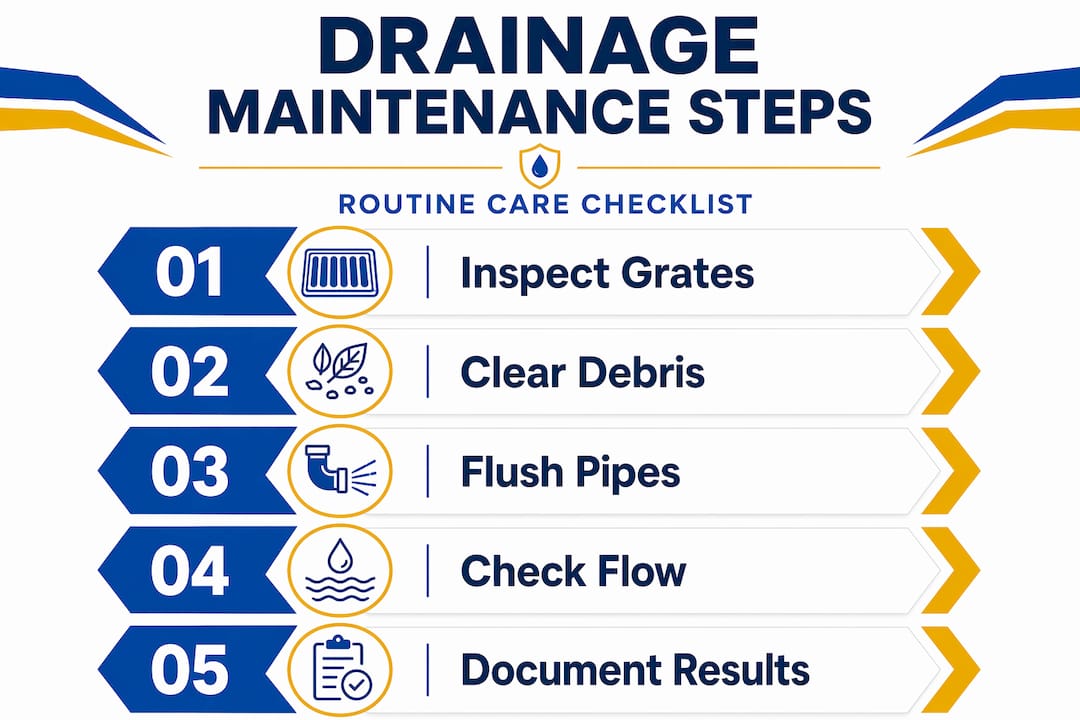
A solid drainage cleaning guide is not about doing everything at once. It is about knowing what to do, how often, and in what order. Here is a practical maintenance sequence you can adapt to your property.
-
Clear surface drains and gullies (monthly or after heavy rain). Remove debris, leaves, and silt by hand or with a hose. If water pools around the gully even after clearing, there may be a partial blockage lower down.
-
Inspect and clear gutters and downspouts (every three months). Blocked gutters are one of the most overlooked causes of damp and structural damage. Use a ladder, gloves, and a bucket. Check that water flows freely through the downspout to its discharge point.
-
Check downspout extension distances (quarterly). Downspout discharge points should be extended 5 to 10 feet from foundations to prevent soil saturation. Three feet is not enough. If you have clay soil, aim for 7 to 10 feet because clay holds moisture and transfers hydrostatic pressure directly to your foundations. Worth noting: splash blocks typically move water only 2 to 3 feet from a foundation, which is rarely sufficient on its own.
-
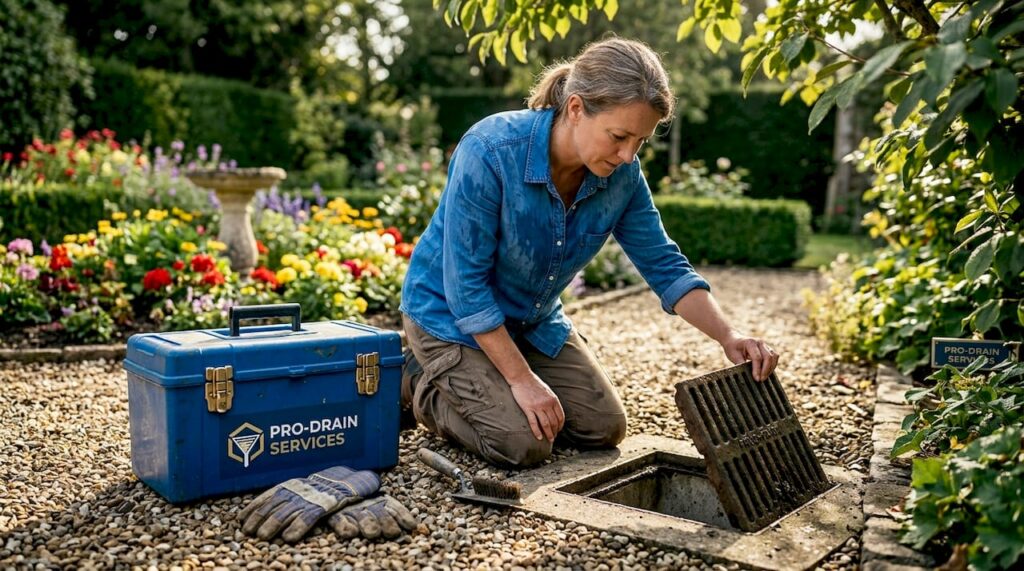
Check inspection chambers (every six months). Lift the cover carefully, check for signs of surcharging (water higher than expected), root intrusion, or cracked walls. Take a photo for your records.
-
Monitor grease traps on commercial properties (weekly to quarterly). Grease trap cleaning frequency varies significantly depending on kitchen output. High-volume kitchens typically need servicing weekly or fortnightly. Standard restaurants work on a one to three month cycle. Large outdoor interceptors are often cleaned quarterly. The trigger for cleaning is not the calendar. It is fill level.
-
Service grease traps when they reach the 25% threshold. The 25% fill rule is the industry standard: once fats, oils, grease, and solids occupy 25% of trap capacity, separation efficiency drops sharply. Beyond that point, you risk sewer bypass and regulatory fines.
-
Schedule a professional inspection annually. This applies to both residential and commercial properties. Professionals use CCTV technology to identify root intrusion, pipe collapse, or joint failure that no visual check from above ground will catch.
Pro Tip: Set phone reminders tied to the seasons rather than dates. Spring and autumn maintenance aligns naturally with when trees shed debris and when rainfall increases, making it easier to remember and easier to stay consistent.
Pair this sequence with a drainage maintenance checklist to track what has been done and when, especially if you manage multiple properties.
Spotting problems and avoiding costly mistakes
Most drainage failures are not sudden events. They announce themselves weeks or even months in advance. Knowing what to look for is half the battle.
Warning signs you should never ignore:
- Slow-draining sinks, baths, or shower trays, particularly when multiple fixtures slow at the same time
- Unpleasant odours from drains, especially when no individual fixture is blocked
- Water pooling on driveways or lawns after moderate rainfall
- Damp patches on ground-floor walls or a persistent musty smell in basements
- Gurgling sounds from toilets or drains when other fixtures are in use
Drainage problems that could have been fixed for a few hundred pounds often become four-figure repair bills when ignored for a single season. The signs are rarely subtle.
Common mistakes that make things worse:
- Pouring chemical drain cleaners repeatedly. Caustic chemicals can corrode older clay or cast-iron pipes, and they rarely solve root-cause blockages. They just delay them.
- Assuming short downspout extensions are adequate. A downspout discharging too close to a foundation is one of the most commonly overlooked causes of moisture damage and costly repairs.
- Skipping compliance records on commercial sites. Storm drain inspections at commercial properties should be conducted regularly, with documentation retained for at least 3 years to meet regulatory requirements. Ignoring this is not just a maintenance error. It is a legal risk.
- Overlooking tree root proximity. If there are mature trees near your drainage runs, roots are almost certainly a factor. This is not something drain rods will fix permanently.
Pro Tip: Photograph every inspection, even when nothing appears wrong. A timestamped photo library is your strongest evidence if a neighbouring property ever disputes the source of a drainage problem.
For property managers dealing with ongoing drain issues, reviewing your commercial drainage approach can surface patterns that routine visual checks miss entirely.

Verifying results and planning for the long term
Once you have run through your maintenance tasks, the work is not finished. Verification matters as much as the maintenance itself.
-
Run water through every fixture and drain after maintenance. Watch for slow flow, gurgling, or overflow at any point. If anything behaves differently from before, investigate immediately rather than waiting.
-
Walk the perimeter of your property after heavy rain. Look for waterlogging near foundations, overflow from gutters, and whether downspout discharge points are directing water away effectively.
-
Book a CCTV drain survey every two to three years. This is especially important for properties over 15 years old or those with a history of blockages. A CCTV drain survey gives you a precise internal view of pipe condition, joint integrity, and any encroaching roots.
-
Review and update your drainage records. Local authorities can require maintenance documentation retention for at least 3 years. Good records also give you a baseline to compare against year on year.
-
Consider long-term structural solutions. If surface water management is a recurring problem, perimeter drainage systems with perforated piping and sump pumps are worth considering. Proper slope in underground drainage systems, a minimum of 1% gradient, is non-negotiable for maintaining gravity flow and avoiding freeze damage in winter.
| Solution type | Best suited for | Typical lifespan |
|---|---|---|
| Surface gully clearing | Regular preventive upkeep | Ongoing |
| Downspout extension | Protecting foundations from water ingress | Permanent with proper installation |
| CCTV survey | Diagnosing hidden or recurring pipe issues | One-off with periodic repeats |
| Perimeter drainage system | Properties with persistent waterlogging | 20 to 50 years with maintenance |
| Sump pump installation | Basements or low-lying properties | 10 to 15 years before replacement |
My honest take on drainage maintenance
I have spoken with dozens of homeowners and landlords over the years, and the pattern I see most often is the same: drainage maintenance only becomes a priority the day it fails. Someone discovers a flooded garage after an autumn storm, or a tenant calls about sewage smell in the kitchen, and suddenly there is urgency. The frustrating part is that most of these situations were preventable, often with a single inspection earlier in the year.
What I have found genuinely useful is treating drainage the way you treat a car service. You do not wait for the warning light. You book it on a schedule and trust that prevention costs less than breakdown. A proper drainage system maintenance workflow, even a simple one, puts you in control before the problem appears rather than scrambling after it.
The other thing I would push back on is the idea that professional help is only for emergencies. A trained drainage engineer will spot root intrusion, pipe deformation, or joint failure that nobody doing a surface-level check would ever notice. Combining your own regular vigilance with a home drainage inspection from a qualified professional every couple of years is simply a smarter approach than doing everything yourself or doing nothing at all.
The importance of drainage maintenance is not abstract. It is the difference between a dry, structurally sound property and one that costs you money every single season.
— Ronnie
Professional drainage support when you need it

Understanding how to maintain drainage is one thing. Having expert support when a problem goes beyond what you can handle yourself is what protects your property in the long run. Localservicesdrainage provides professional drain unblocking, CCTV surveys, and repair services across southern UK, with fast response times and long-term repair guarantees. Whether you need help with a stubborn blockage, a full drainage inspection, or advice on a persistent water management issue, the team is ready to help. Start with our step-by-step drain unblocking guide or get in touch directly to book an inspection.
FAQ
How often should I carry out drainage maintenance?
For residential properties, a quarterly check of gutters, downspouts, and surface drains covers most preventive needs. Commercial properties, particularly those with grease traps, may require monthly monitoring.
What is the 25% rule for grease traps?
The 25% rule means a grease trap should be cleaned before fats, oils, grease, and solids reach 25% of its total capacity. Exceeding this level reduces separation efficiency and risks sewer bypass.
How far should a downspout extend from my house?
Downspouts should discharge at least 5 feet from your foundation, with 7 to 10 feet recommended in clay soils. Splash blocks alone are rarely sufficient and should be combined with extended piping.
When should I call a professional drainage company?
Call a professional when you notice recurring blockages, sewage smells, multiple slow-draining fixtures at once, or any sign of structural damage such as sunken ground near drainage runs. A CCTV survey is the most reliable way to diagnose the root cause.
Do commercial property managers need to keep drainage records?
Yes. Commercial properties are typically required to retain inspection records and maintenance documentation for at least 3 years to demonstrate stormwater compliance with local regulatory requirements.