Neglecting commercial drainage carries risks many property owners underestimate until facing costly repairs, regulatory penalties, or unexpected business interruptions. Southern UK commercial properties face unique challenges from regional weather patterns, ageing infrastructure, and strict local authority oversight. Proper drainage maintenance isn’t just about avoiding blocked pipes. It protects your investment, ensures legal compliance, and maintains uninterrupted operations. This guide explains why commercial drainage safeguarding businesses demands consistent attention, how it shields your property from expensive failures, and practical steps tailored for southern UK facilities to implement effective maintenance programmes.
Table of Contents
- Key takeaways
- Understanding the importance of commercial drainage maintenance
- Financial and operational consequences of poor drainage upkeep
- Tailored maintenance strategies for southern UK commercial properties
- Benefits of professional commercial drainage services and technology
- Discover expert drainage solutions for your commercial property
- Frequently asked questions about commercial drainage maintenance
Key Takeaways
| Point | Details |
|---|---|
| Legal compliance mandatory | UK law imposes duties on commercial property owners to maintain private drainage connecting to public sewers, with penalties for breaches. |
| Proactive maintenance saves disruption | Regular inspections and maintenance help prevent blockages and unplanned downtime, avoiding costly emergency repairs. |
| Southern region focus | Regional weather, ageing infrastructure and strict local authority oversight mean maintenance programmes must be tailored for southern England. |
| Environmental and safety duties | Maintaining drainage reduces pollution risks to watercourses and helps meet health and safety and environmental regulations for food service, healthcare and manufacturing facilities. |
Understanding the importance of commercial drainage maintenance
Commercial drainage encompasses all wastewater systems serving business premises, from restaurant kitchens and manufacturing facilities to office buildings and retail spaces. These systems handle substantially higher volumes and more varied waste than residential drains, making them vulnerable to blockages, structural deterioration, and contamination risks. Understanding commercial drainage in UK properties provides the foundation for recognising why maintenance cannot be optional.
UK law places clear responsibilities on commercial property owners and occupiers. The Water Industry Act establishes duties for maintaining private drainage systems connecting to public sewers. Wiltshire sewage and drainage regulations and similar county council requirements under Land Drainage Acts govern surface water management across southern regions. These regulations aren’t suggestions. They carry enforcement powers including fines, remediation orders, and potential prosecution for serious breaches.
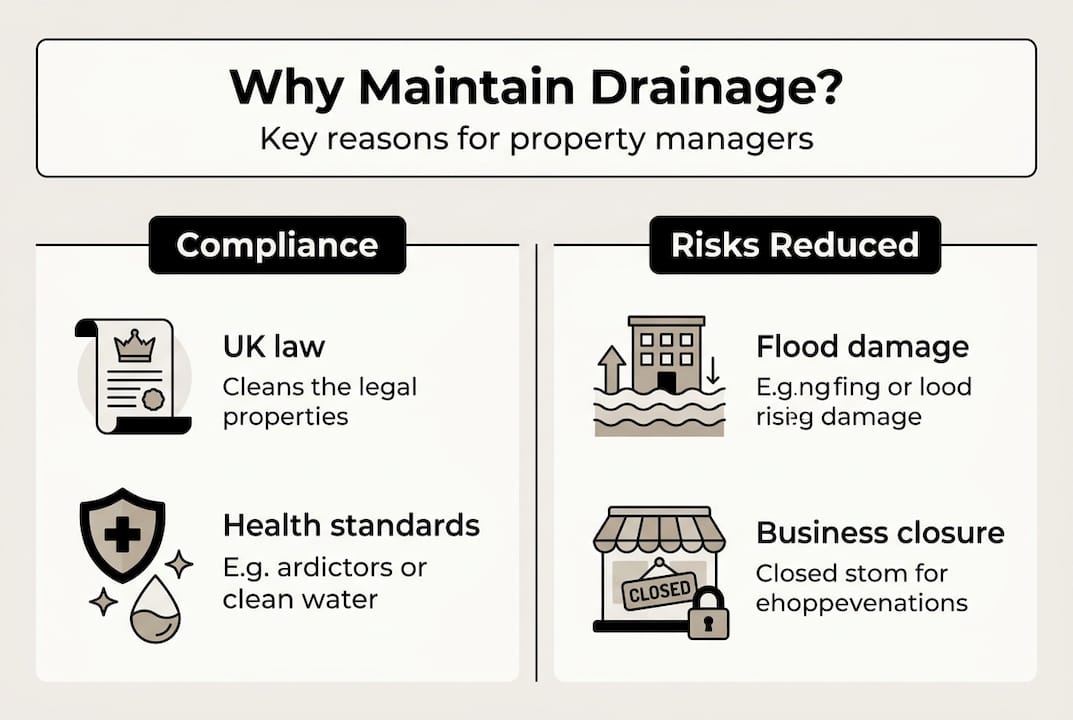
Health and safety standards add another compliance layer. Food service establishments must maintain grease traps and prevent contamination under Food Safety Act provisions. Healthcare facilities face stringent infection control requirements affecting drainage hygiene. Manufacturing sites handling chemicals or industrial waste must prevent environmental contamination through proper drainage management. Maintenance ensures compliance with UK health, safety, and environmental regulations, avoiding fines and legal action.
Environmental protection goals extend beyond your property boundaries. Poorly maintained drainage can discharge pollutants into watercourses, trigger flooding on neighbouring land, or contaminate groundwater supplies. Southern Water and Wessex Water actively monitor commercial properties for environmental violations. The Environment Agency prosecutes serious pollution incidents, with penalties reaching tens of thousands of pounds plus remediation costs.
Risks of non-compliance create genuine business threats:
- Financial penalties from local authorities and water companies for drainage violations
- Legal action from neighbouring properties affected by drainage failures
- Enforcement notices requiring immediate costly repairs
- Business closure orders for serious health and safety breaches
- Increased insurance premiums or policy cancellations following incidents
- Reputational damage affecting customer confidence and tenant retention
Pro Tip: Schedule annual compliance audits with drainage specialists familiar with your local authority requirements. This proactive approach identifies potential violations before enforcement action threatens your operations.
Financial and operational consequences of poor drainage upkeep
The financial toll of drainage neglect extends far beyond initial repair bills. UK blockages from mis-flushing cost £143M annually, with commercial properties bearing disproportionate expenses due to system complexity and business interruption costs. Individual repair incidents range from £600 for minor blockages to £4,000+ for structural failures requiring excavation. Inadequate maintenance causes approximately 25% of building damages in commercial properties, creating cascading expenses through water damage, structural repairs, and lost trading time.
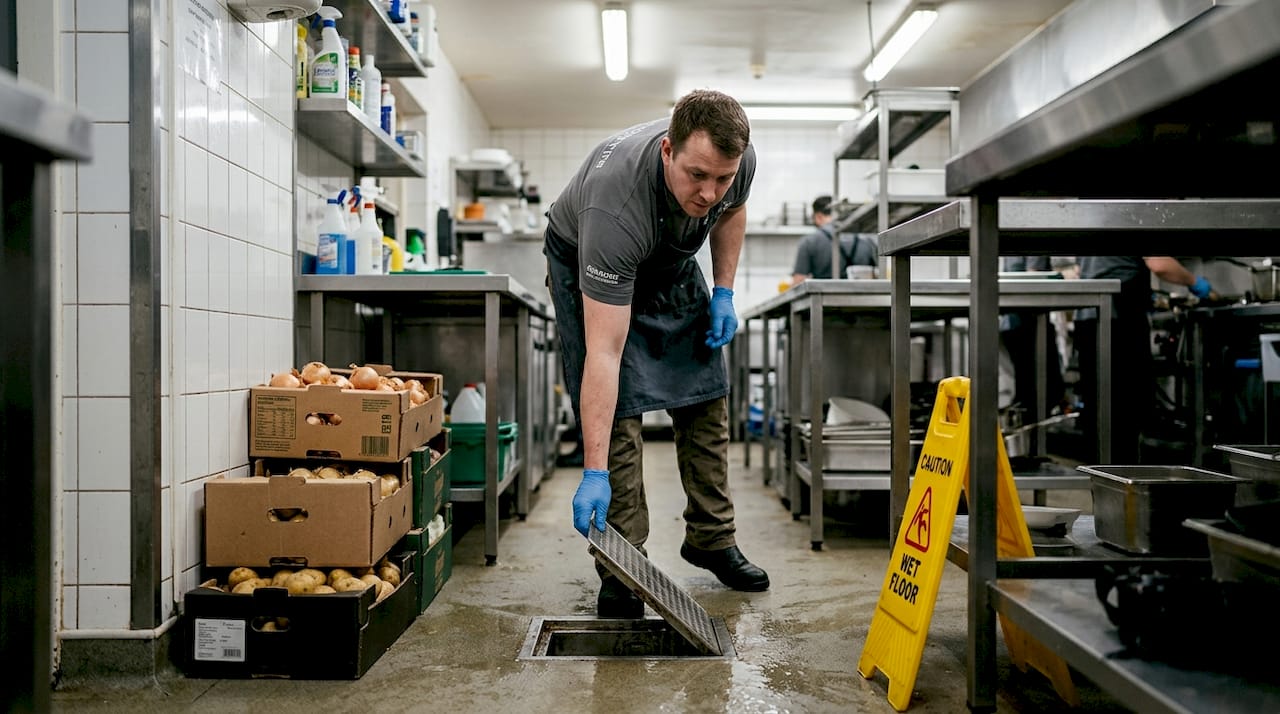
Operational disruption often exceeds direct repair costs. A blocked drain in a restaurant kitchen forces immediate closure until resolved, losing thousands in daily revenue plus staff wages for idle employees. Retail premises experiencing drainage odours or visible problems drive customers away, damaging sales and brand reputation. Office buildings with malfunctioning facilities create health hazards and productivity losses. Manufacturing operations halt completely when drainage failures prevent safe production.
Repair cost escalation follows predictable patterns when maintenance lapses. A small blockage costing £200 to clear becomes a £1,500 repair when ignored until pipes crack. That cracked pipe evolves into £8,000+ excavation work once surrounding structures sustain water damage. The compounding effect means deferred maintenance multiplies expenses exponentially rather than linearly.
Common causes of commercial drainage failure include:
- Grease and fat accumulation in food service facilities blocking pipes gradually
- Foreign objects flushed by staff or customers creating immediate blockages
- Tree root infiltration through pipe joints in older systems
- Structural deterioration from age, ground movement, or heavy vehicle traffic
- Inadequate system capacity for business expansion or changed usage patterns
- Lack of regular cleaning allowing gradual buildup of debris and scale
Understanding drainage maintenance to prevent floods reveals how small investments in routine care eliminate these expensive failure modes. A quarterly inspection costing £150 identifies developing problems whilst they remain simple fixes. That same issue left unaddressed becomes an emergency callout at premium rates, often occurring outside business hours when repair costs triple.
Pro Tip: Track all drainage maintenance and repair costs monthly. This data reveals patterns showing which areas need more frequent attention and helps justify maintenance budgets by quantifying savings versus reactive repair expenses.
Tailored maintenance strategies for southern UK commercial properties
Southern UK commercial properties operate under specific regulatory frameworks shaped by regional water authorities and county councils. Wessex Water serves Wiltshire, Somerset, Bristol, and surrounding areas, whilst Southern Water covers Hampshire, West Sussex, Kent, and neighbouring counties. Focus on Wessex Water and Southern Water areas where Land Drainage Act responsibilities fall to county councils including Wiltshire Council and West Sussex County Council. These authorities enforce different requirements for surface water management, trade effluent discharge, and private drainage maintenance.
Inspection frequency depends on your facility type and usage intensity. High-risk premises like restaurants, food processing plants, and healthcare facilities need quarterly professional inspections. Standard commercial offices and retail spaces typically require biannual checks. Industrial sites handling chemicals or heavy wastewater demand monthly monitoring. Emergency service becomes necessary when you observe slow drainage, recurring blockages, unusual odours, or visible sewage backup.
Proactive versus reactive maintenance approaches show stark differences:
| Approach | Activities | Cost Pattern | Outcome |
|---|---|---|---|
| Proactive | Scheduled cleaning, CCTV surveys, preventative repairs | Lower annual cost, predictable budgeting | Prevents emergencies, extends system life, maintains compliance |
| Reactive | Emergency callouts, crisis repairs, damage restoration | Higher total cost, unpredictable spikes | Frequent disruptions, shortened equipment life, compliance risks |
Implementing effective commercial drainage tips southern UK properties requires systematic approaches. Follow this maintenance checklist adapted for commercial drainage:
- Document your complete drainage system layout including pipe locations, access points, and connection to public sewers
- Establish baseline condition through comprehensive CCTV survey identifying existing defects and vulnerable areas
- Create maintenance schedule based on facility type, usage intensity, and regulatory requirements
- Train staff on proper disposal practices preventing common blockage causes like grease, wipes, and foreign objects
- Install appropriate preventative equipment including grease traps, lint filters, and sediment interceptors where needed
- Conduct regular visual inspections of accessible drainage points checking for slow flow, odours, or visible problems
- Schedule professional cleaning and CCTV surveys at frequencies matching your risk profile
- Maintain detailed records of all inspections, cleaning, repairs, and compliance checks for regulatory and insurance purposes
- Review and update your maintenance programme annually based on system performance and any operational changes
- Establish relationships with approved contractors capable of emergency response within your service area
Following this commercial drainage checklist steps systematically addresses both immediate maintenance needs and long-term system protection. The structured approach ensures nothing gets overlooked whilst creating documentation proving compliance if authorities or insurers request evidence.
Pro Tip: Engage local authorised contractors familiar with Wessex and Southern Water practices for compliance and efficiency. Their regional expertise navigates specific requirements faster than national firms unfamiliar with local authority expectations and approval processes.
Benefits of professional commercial drainage services and technology
Modern drainage maintenance extends far beyond basic cleaning through advanced diagnostic technologies. CCTV drain surveys employ high-resolution cameras on flexible cables to inspect pipe interiors without excavation. These surveys identify cracks, root intrusion, misaligned joints, scale buildup, and structural weaknesses invisible from surface observations. The visual evidence pinpoints exact problem locations, enabling targeted repairs rather than exploratory digging across wide areas.
Professional cctv drain survey services provide detailed reports documenting current condition, highlighting immediate concerns, and forecasting potential future problems. This intelligence transforms maintenance from guesswork into data-driven decision making. You know precisely which sections need attention, what repairs will cost, and how urgently work must proceed. Insurance claims benefit from video evidence documenting pre-existing conditions versus new damage.
Comprehensive services professionals offer include:
- Regular maintenance contracts providing scheduled inspections and cleaning at fixed annual costs
- High-pressure water jetting removing grease, scale, and debris without damaging pipes
- Drain unblocking services for emergency situations requiring immediate response
- Structural repairs including patch lining, junction repairs, and full pipe replacement where necessary
- Compliance inspections and documentation meeting regulatory requirements for your industry and location
- Trade effluent monitoring and management for facilities discharging to public sewers
- Preventative equipment installation and maintenance including grease traps and interceptors
Expert services help meet health and environmental laws efficiently by understanding exactly what regulations require and how inspectors evaluate compliance. They navigate the complex intersection of Water Industry Act duties, Land Drainage Act responsibilities, Environmental Protection Act requirements, and industry-specific health and safety standards. This expertise prevents costly mistakes from well-intentioned but uninformed maintenance attempts.
Maintenance ensures compliance with UK health, safety, and environmental regulations, avoiding fines and legal action. Proper drainage upkeep protects businesses from enforcement action whilst safeguarding public health and environmental quality.
The economic case for professional services becomes clear when comparing costs. A maintenance contract averaging £1,200 annually prevents emergency repairs typically costing £2,000 to £5,000 per incident. Businesses experiencing even one emergency annually save money through proactive contracts whilst gaining predictable budgeting and operational continuity. The return on investment multiplies for high-risk facilities facing multiple potential incidents yearly.
Professional commercial drainage maintenance services bring specialist equipment, technical expertise, and regulatory knowledge that in-house staff rarely possess. Their experience across hundreds of commercial properties means they recognise problems faster, implement solutions more effectively, and prevent recurrence through proven techniques.
Pro Tip: Scheduling periodic CCTV surveys can significantly reduce emergency repairs and prolong drain lifespan. Annual surveys for high-risk premises or biennial surveys for standard commercial properties catch deterioration early when repairs remain simple and inexpensive rather than waiting for catastrophic failures.
Discover expert drainage solutions for your commercial property
Protecting your commercial property from drainage failures requires more than good intentions. It demands specialist knowledge, advanced diagnostic tools, and systematic maintenance programmes tailored to your facility’s specific risks and regulatory environment. Professional drainage services transform this complex challenge into manageable, predictable protection for your investment and operations.
Our commercial drainage maintenance services provide comprehensive solutions designed specifically for southern UK commercial properties. We understand Wessex Water and Southern Water requirements, navigate county council regulations efficiently, and deliver maintenance programmes preventing expensive failures whilst ensuring full compliance. Our professional cctv drain survey technology identifies problems before they escalate, and our commercial drain unblocking services respond rapidly when emergencies occur. Discover how expert drainage care safeguards your property, protects your business continuity, and delivers long-term savings through proactive protection rather than reactive crisis management.
Frequently asked questions about commercial drainage maintenance
How often should commercial drains be maintained?
Maintenance frequency depends on your facility type and usage intensity. High-risk premises like restaurants and food processing plants need quarterly professional inspections and cleaning. Standard commercial offices and retail spaces typically require biannual maintenance. Industrial facilities handling chemicals or heavy wastewater should schedule monthly monitoring to prevent contamination and ensure compliance.
What are signs of drainage problems in commercial properties?
Watch for slow drainage in sinks, toilets, or floor drains indicating developing blockages. Unusual odours suggest trapped waste or ventilation problems. Gurgling sounds when water drains signal air pressure issues from partial blockages. Visible sewage backup or water pooling around drains demands immediate professional attention to prevent health hazards and property damage.
Who is responsible for maintaining commercial drainage under UK law?
Property owners and occupiers share responsibility depending on lease terms and system ownership. Owners must maintain private drainage systems up to the connection point with public sewers under Water Industry Act provisions. Tenants typically handle day-to-day care and minor blockages whilst owners address structural repairs. Commercial drainage explained clarifies these responsibilities for different property arrangements.
Can neglecting drainage maintenance affect business insurance?
Yes, significantly. Insurance policies often exclude claims resulting from lack of reasonable maintenance or gradual deterioration. Insurers may refuse coverage for drainage damage if you cannot demonstrate regular professional inspections and appropriate care. Some policies require documented maintenance programmes as coverage conditions, and claims history from drainage incidents increases future premiums substantially.
What technologies can detect issues early in drainage systems?
CCTV drain surveys provide the most comprehensive early detection, using high-resolution cameras to inspect pipe interiors and identify cracks, root intrusion, blockages, and structural weaknesses before they cause failures. Sonar profiling measures pipe diameter changes indicating scale buildup. Smoke testing reveals hidden leaks and improper connections. Thermal imaging detects blockages and leaks in buried pipes without excavation.