TL;DR:
- Drainage compliance often becomes a priority only after issues or violations occur, risking costly penalties. A detailed checklist helps property owners ensure adherence to legal standards, maintain proper records, and prevent failures during audits. Regular inspections, proper documentation, and professional assessments are essential for ongoing drainage system compliance and property value protection.
Drainage compliance slips down the priority list for many property owners and managers until something goes wrong. A failed audit, a blocked inspection chamber no one knew existed, or a penalty notice from the local authority can cost far more than any routine inspection. A thorough drainage compliance checklist is your most reliable way to stay ahead of these problems, meet legal obligations, and protect the long-term value of your property. This article walks you through exactly what the checklist must cover, how often to apply it, and what mistakes to avoid.
Table of Contents
- Key takeaways
- 1. What a drainage compliance checklist actually requires
- 2. Visual inspection of drains and inspection chambers
- 3. Pipe condition, gradients, and flow checks
- 4. Rainwater disposal and soakaway assessment
- 5. Documentation: what to record and how
- 6. Comparison of compliance requirements by property type
- 7. Common pitfalls that cause compliance failures
- 8. Practical steps for audit readiness and ongoing compliance
- My honest view on drainage compliance diligence
- How Localservicesdrainage can support your compliance
- FAQ
Key takeaways
| Point | Details |
|---|---|
| Know your legal framework | Building Regulations Part H sets the minimum standards for drainage design, access, and maintenance in the UK. |
| Inspect on a regular schedule | Depending on property type, inspections should occur weekly, biweekly, or within 24 hours after significant rainfall. |
| Keep records for at least three years | Inspection logs, maintenance records, and corrective action evidence must be retained to satisfy audit requirements. |
| Access is a compliance issue | Blocked or buried inspection chambers are the single most common reason building control inspections fail. |
| Document deferrals and repairs | Skipped inspections and delayed corrective actions must always be recorded with a clear reason to avoid audit penalties. |
1. What a drainage compliance checklist actually requires
Before you open the inspection chamber lid or pick up a torch, you need to understand the legal framework that defines what compliance means. In England and Wales, the primary reference point is Building Regulations Part H, which covers foul water drainage, rainwater disposal, and the design and access requirements for drainage systems serving residential and commercial buildings.
Part H does not just apply when you build something new. Extensions, loft conversions, and even significant landscaping changes can trigger compliance checks, particularly where drainage routes or inspection chamber access may be affected. If your property sits close to a public sewer, build-over agreements from your local water authority may also be required before any groundworks begin.
Inspection frequency is where many property owners fall short. Under the EPA Construction General Permit framework, operators must choose between weekly or biweekly inspections combined with post-storm checks within 24 hours for any rainfall event reaching 0.25 inches or more. UK guidance follows a similar principle of regular, documented assessments.
From a recordkeeping perspective, you are legally expected to retain inspection logs, maintenance records, and corrective action evidence. Three years is the minimum record retention period you should plan for. Regulators and auditors will want to see that records are contemporaneous, not reconstructed after the fact.
Pro Tip: Before arranging any building work that affects your garden or driveway, locate all your inspection chambers on a site plan first. Paving over one by accident is a common and costly compliance failure.
2. Visual inspection of drains and inspection chambers
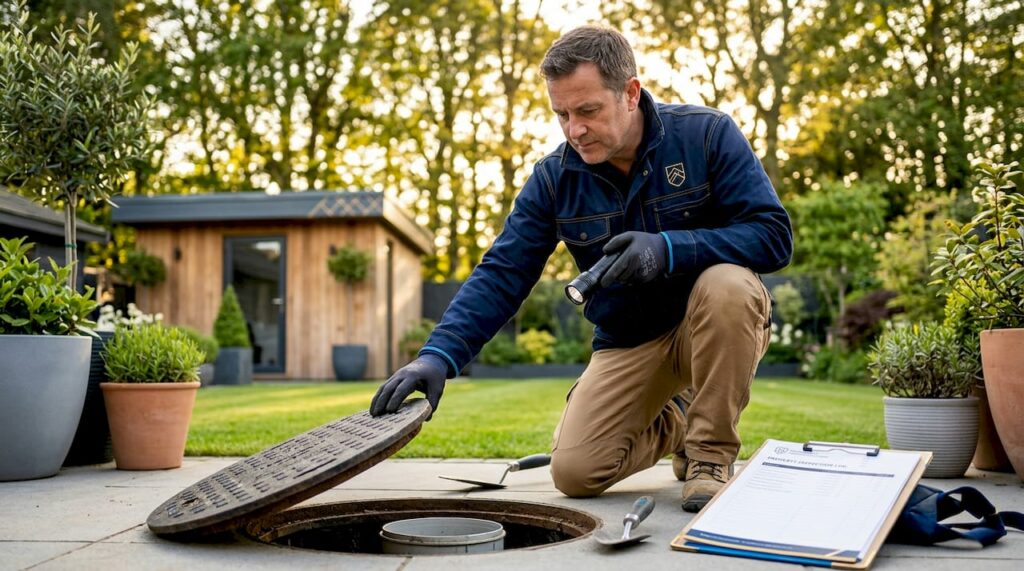
A site drainage evaluation starts at the surface. Walk the property and locate every inspection chamber and manhole cover. These should be clear of obstruction, labelled where possible, and in sound structural condition. Cracked or sunken covers are not just a trip hazard. They are a sign that the chamber below may be compromised.
When you lift the cover, check for:
- Signs of standing water or slow drainage
- Evidence of root ingress, sediment build-up, or grease accumulation
- Cracking or joint separation on the chamber walls
- Corrosion on metal components including step irons and frames
Inspection chambers and manholes must be accessible and spaced no more than 45 metres apart on straight runs, with chambers required at every change of direction. If your site cannot meet this standard because a chamber has been buried or built over, that is a compliance failure that needs correcting before any audit.
Pro Tip: Take dated photographs during every visual inspection. A smartphone photo with location data is simple evidence that can prove your inspection actually happened on the date recorded.
3. Pipe condition, gradients, and flow checks
What you cannot see from the surface matters as much as what you can. Pipe gradient and diameter directly affect whether a drainage system can maintain self-cleansing velocity. The minimum foul water drain diameter is 100mm, and gradients must be sufficient to prevent solids settling in the pipe. Where this standard is not met, blockages become frequent and structural damage accelerates.
During your compliance checklist for drainage, record the pipe sizes you can confirm and note any areas where gradient appears inadequate based on drainage behaviour. Persistent slow drainage in a specific run is usually a gradient problem, not a blockage, and the two require very different remedies.
For a deeper diagnostic, a CCTV survey is the most reliable method. A camera fed through the pipe gives you a real-time picture of internal condition, including cracks, displaced joints, and root intrusion that no surface inspection can reveal. This is particularly useful on properties with drainage systems older than 20 years.
4. Rainwater disposal and soakaway assessment
Rainwater drainage is a separate system from foul drainage, and it needs its own section on your checklist. Roof drainage, gutter outlets, and surface water runs should all discharge to an approved point. That might be a soakaway, a watercourse, or a surface water sewer, depending on your location and the local drainage requirements guide produced by your council.
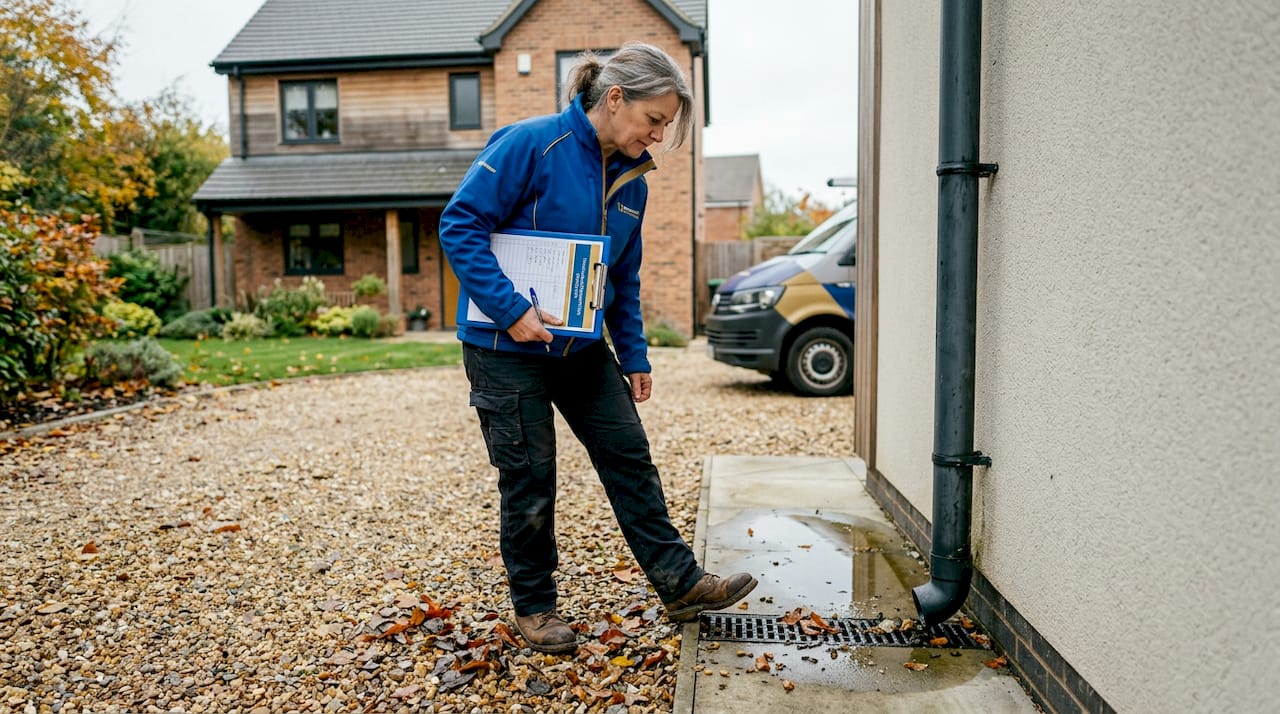
Soakaways need periodic assessment. If a soakaway is taking longer than 24 hours to empty after a significant rainfall event, it is likely failing. This can cause localised flooding, damage to foundations, and in some cases contamination of ground water.
Check that rainwater pipes are not connected to foul water drains. Cross-connections are more common than many property managers realise, particularly in older properties, and they constitute a serious compliance breach. Your drainage inspection guide should document each system separately with clear confirmation of where every outlet discharges.
5. Documentation: what to record and how
Records are not bureaucracy for its own sake. Inspection reports function as legal evidence during audits, and the strength of your compliance position is only as good as the paper trail behind it. Every inspection must be recorded on the day it is carried out, with the inspector’s name, the date, findings, and any corrective actions identified.
When an inspection cannot go ahead as scheduled, that also needs to be recorded. Deferred inspections must be logged with the exact date, time, and the specific reason for deferral. Missing this step is one of the most common causes of audit failures, even where the actual drainage system is in good condition.
Your records should follow a consistent format and be stored somewhere accessible. If a building control officer or environmental inspector visits and asks to see your last 12 months of inspection logs, you need to be able to produce them promptly and in order. Digital systems are increasingly the preferred approach, and we cover those in section 8.
6. Comparison of compliance requirements by property type
Different property types carry different obligations. The table below summarises how a compliance checklist for drainage varies across the most common categories.
| Compliance element | Residential property | Commercial property | Mixed-use / multi-unit |
|---|---|---|---|
| Inspection frequency | Biannual minimum | Monthly or biweekly | Monthly with post-storm checks |
| Post-storm inspection | After severe events | Within 24 hours of qualifying rain | Within 24 hours |
| Record retention | 3 years minimum | 3 years minimum | 3 years minimum |
| Access requirements | Part H standards | Part H plus site-specific permits | Part H plus build-over agreements |
| Common compliance challenge | Buried chambers from renovations | Missing corrective action records | Cross-connections between tenancies |
| Recommended inspection method | Visual plus periodic CCTV | CCTV survey and drainage logs | Full CCTV survey with drainage map |
| Local authority coordination | On extensions or new installs | Ongoing via site drainage evaluation | Required for sewer connections |
The comparison makes clear that commercial and mixed-use properties face more frequent inspection obligations and stricter documentation requirements. If you manage multiple units or a commercial site, the construction drainage checklist you use should reflect those higher standards.
7. Common pitfalls that cause compliance failures
Most drainage compliance failures are preventable. They do not arise from complex engineering problems. They arise from routine oversights that compound over time. Understanding where others go wrong is one of the fastest ways to protect yourself.
The most frequent issues include:
- Blocked or inaccessible chambers. Blocked access to inspection chambers due to building work or landscaping is the leading cause of failed building control inspections. Always verify chamber locations before any groundworks begin.
- Undocumented deferred inspections. Skipping an inspection without recording the date, time, and reason is treated as a compliance violation in its own right, regardless of the condition of the drains.
- Incomplete corrective action records. Failed audits are frequently traced to missing evidence linking identified issues to the repairs that followed. Record the problem and the fix together.
- Delayed repairs. Corrective actions must be completed within seven days or before the next storm event, whichever comes sooner. Letting issues sit unresolved is a compliance breach in itself.
- No coordination with the sewer authority. Building near or over a public sewer without a build-over agreement is a serious breach that can lead to enforcement action and costly reinstatement works.
“The drainage system is only as compliant as the evidence behind it. If you cannot show that an issue was found and fixed in the right timeframe, it may as well not have been fixed at all.”
8. Practical steps for audit readiness and ongoing compliance
Getting compliant once is relatively straightforward. Staying compliant across months and years requires a system rather than a one-off effort. Here is how to make the compliance checklist for drainage a sustainable part of your property management routine.
- Build a compliance calendar. Schedule inspections, maintenance visits, and record reviews in advance. Treat them with the same priority as rent collection or fire safety checks.
- Use digital tools. Property management software or even a shared spreadsheet with dated entries and photo attachments is significantly more defensible in an audit than handwritten notes kept in a folder. Date-stamped digital records are harder to dispute.
- Commission CCTV surveys periodically. A professional CCTV drainage survey every two to three years is good practice on any property and invaluable on older sites. It provides a baseline record of pipe condition that supports every subsequent inspection.
- Assign clear responsibility. In multi-unit or commercial properties, somebody must own each compliance task. Ambiguity about who is responsible for drainage checks is how six-month gaps in inspection records occur.
- Engage specialists for complex issues. When you find something you cannot assess yourself, such as a suspected fracture, a collapsed pipe, or a cross-connection, call in a professional rather than logging it as a visual anomaly and moving on.
Pro Tip: For a step-by-step walkthrough of what a professional drainage inspection covers, the guide on how to check drainage compliance at home is a practical companion to this checklist.
My honest view on drainage compliance diligence
I’ve seen the same pattern play out more times than I can count. A landlord or property manager is perfectly on top of rent, safety certificates, and boiler servicing, but drainage compliance is sitting in a blind spot. Not from negligence, but simply because drains are underground and mostly invisible until something fails.
What I’ve found is that the property owners who fare best in audits are not always the ones with the most sophisticated drainage systems. They’re the ones who kept the records. A simple, dated log of inspections, findings, and any work carried out is worth more in a regulatory conversation than thousands of pounds worth of drainage works with no paper trail to show for it.
The access issue is the one I want to stress most. I’ve seen cases where a perfectly compliant drainage system became a compliance problem overnight because a new driveway was poured over an inspection chamber nobody knew was there. Locating and mapping your chambers before any surface works begin should be non-negotiable. It takes minutes and can save you months of dispute.
My advice is this: treat the drainage compliance guide as a living document for your property. Review it after any building work, any change of tenancy, and any significant weather event. Drainage compliance is not a one-time task. It is a habit.
— Ronnie
How Localservicesdrainage can support your compliance
Keeping on top of drainage compliance is significantly easier when you have a reliable specialist on call. Localservicesdrainage provides professional drain inspections, CCTV surveys, and reactive drain unblocking for residential and commercial properties across the southern UK, with fast response times and thorough written reports you can use as compliance evidence. Whether you need a full drain unblocking service to resolve a live blockage or a scheduled CCTV survey to build your inspection record, the team brings the expertise and documentation standards that regulators expect. For properties where drainage has become complex or where an audit is approaching, getting a professional assessment in place early is the most cost-effective step you can take. Contact Localservicesdrainage today to book an inspection or request a quote.
FAQ
What is a drainage compliance checklist?
A drainage compliance checklist is a structured set of inspection and documentation tasks that property owners use to confirm their drainage systems meet legal standards, including those set out in Building Regulations Part H.
How often should drainage inspections be carried out?
For most residential properties, a minimum of biannual inspections is recommended, with additional checks following significant rainfall events. Commercial and mixed-use sites should inspect monthly or biweekly.
How long must drainage inspection records be kept?
Records including inspection logs, maintenance evidence, and corrective action documentation must be retained for a minimum of three years to satisfy regulatory requirements.
What happens if an inspection chamber is blocked or buried?
Blocked access to chambers is the most common cause of failed building control inspections. The chamber must be made accessible and the issue documented before the system can be considered compliant.
Do I need professional help to maintain drainage compliance?
Many routine inspection and documentation tasks can be carried out by a diligent property owner, but CCTV surveys, pipe condition assessments, and repairs should always be handled by a qualified drainage specialist to meet the required standard.