
TL;DR:
- Landlords are legally responsible for maintaining their property’s drainage systems, including gutters, downpipes, and external pipes. Prompt action, proper documentation, and routine inspections help prevent costly damage and legal disputes. Managing drainage proactively ensures compliance, protects property value, and fosters positive tenant relationships.
Most landlords know they are responsible for keeping a roof over their tenants’ heads. Far fewer realise that the drains beneath their feet carry just as much legal weight. The role of landlords in drainage care is one of the most misunderstood areas of property management in the UK, yet the consequences of getting it wrong range from costly structural repairs to legal action from tenants. This guide cuts through the confusion, sets out your statutory obligations clearly, and gives you practical steps to protect both your property and your tenants.
Table of Contents
- Key takeaways
- Legal framework for landlord drainage duties
- Drainage components you are responsible for
- Landlord vs. tenant: who pays for what?
- Practical strategies for managing drainage well
- What neglect actually costs you
- My honest take on drainage and property management
- How Localservicesdrainage helps landlords stay compliant
- FAQ
Key takeaways
| Point | Details |
|---|---|
| Statutory duty under Section 11 | Landlords cannot contract out of repairing gutters, downpipes, and external drainage under the Landlord and Tenant Act 1985. |
| Structural vs. misuse liability | Pipe collapse and root intrusion are landlord responsibilities; blockages caused by tenant misuse are not. |
| Prompt response matters | Landlords must act within a reasonable timeframe once a drainage issue is reported, or risk tenant legal remedies. |
| Documentation protects you | Keeping inspection logs and repair records is your best defence against disputes and regulatory penalties. |
| Professional diagnosis saves money | CCTV surveys identify hidden problems early, preventing far costlier excavation work later. |
Legal framework for landlord drainage duties
The law on landlord responsibilities for drainage is clearer than most people assume. The problem is that few landlords read it before a problem arises.
Under Section 11 of the Landlord and Tenant Act 1985, landlords in England and Wales have a statutory duty to keep the structure and exterior of a property in repair. This explicitly includes guttering, downpipes, drains, and external pipes that contribute to water ingress or flooding. Critically, this duty cannot be waived by lease terms. You cannot write a clause into a tenancy agreement that shifts this obligation to the tenant. If you try, the clause is simply unenforceable.
In Wales, the Renting Homes (Wales) Act 2016 adds further weight to these obligations by requiring properties to meet fitness standards that encompass drainage and water management. The underlying principle across both pieces of legislation is the same: landlords are responsible for maintaining the systems that keep a property habitable.
There are also common law duties worth noting:
- Nuisance and negligence. If a drainage failure on your property causes flooding to a neighbouring property, you may face liability under common law nuisance even if no tenancy-specific rule applies.
- Health and safety obligations. Persistent damp, mould, or flooding caused by drainage failure can trigger enforcement action from the local authority under the Housing Health and Safety Rating System (HHSRS).
- Scope of private versus public drainage. Property owners are responsible for drainage on private land, while public bodies maintain systems only within rights-of-way or public easements. Knowing where your responsibility ends and the water authority’s begins is genuinely useful when disputes arise.
Understanding what UK law requires from landlords in detail will help you avoid the costly mistake of assuming drainage is someone else’s problem.
Drainage components you are responsible for
A drainage system is not one thing. It is a network of components, and landlords and property drainage management means understanding each part and what can go wrong.
The components that fall under your maintenance obligations typically include:
- Gutters and fascias. These collect rainwater from the roof and direct it away from the building. Blocked or sagging gutters cause water to overflow against walls, which leads to damp and eventual structural damage.
- Downpipes. These carry water from gutters to drains at ground level. Blockages often occur at bends and joints, particularly where leaf debris accumulates.
- External drainage pipes. Any pipe that runs outside the building structure and connects to the main drain or sewer falls within your obligation to maintain.
- Surface water drains. Gullies, channels, and soakaways that manage water run-off from yards, driveways, and gardens are your responsibility on private land.
- Non-return valves. These are not legally mandatory, but installing non-return valves on drain outlets is a prudent flood mitigation measure, particularly in properties situated in flood-risk areas.
Routine maintenance is what keeps these components functioning and your liability manageable. At a minimum, you should schedule annual gutter and downpipe clearances, inspect drainage gullies for debris after storms, and check for visible signs of leakage or joint failure during periodic property visits.
Common warning signs that a system is failing include slow-draining sinks or baths with no obvious cause, gurgling sounds from pipes, water marks on external walls, subsidence or ground movement near drain runs, and persistent unpleasant odours from drains.

Maintaining records of every inspection is not optional. Comprehensive records of inspections and repairs are your primary tool for managing risk and demonstrating compliance if a dispute reaches a tribunal or court.
Pro Tip: Keep a simple digital log that records the date of each inspection, what was checked, what was found, and what action was taken. A shared cloud folder works perfectly for this, and it takes less than ten minutes to update after each visit.
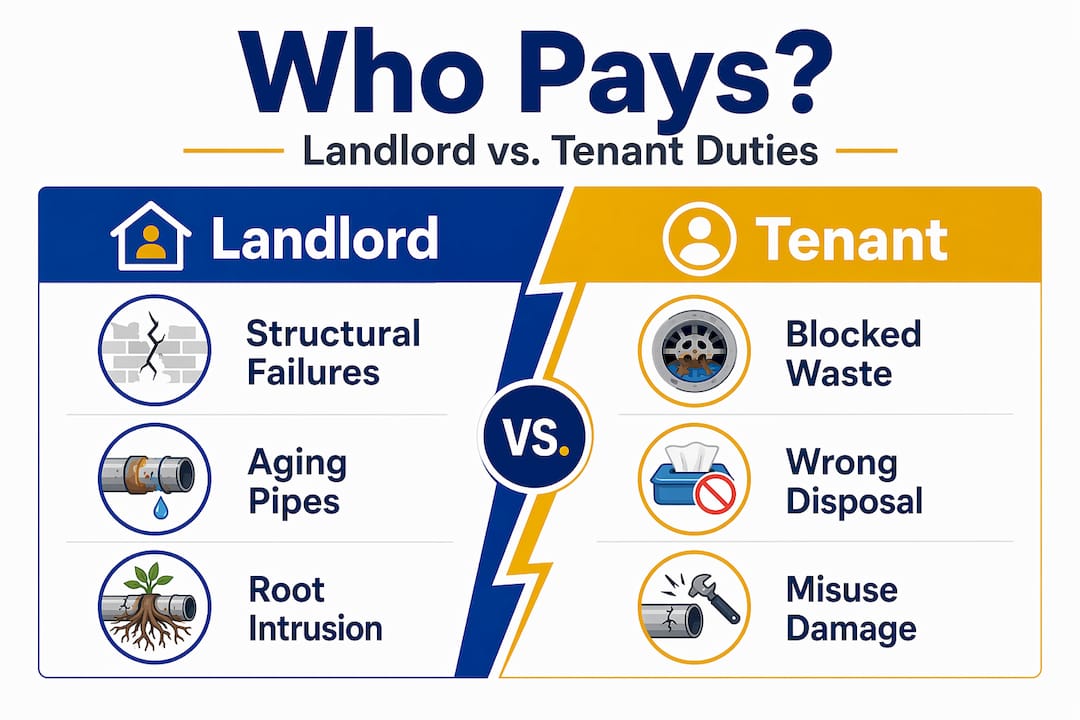
Landlord vs. tenant: who pays for what?
This is where most disputes between landlords and tenants actually originate. The distinction is straightforward in principle but messy in practice.
Liability turns on whether a problem is structural or caused by misuse. The table below sets this out plainly:
| Scenario | Responsible party | Typical evidence |
|---|---|---|
| Pipe collapse due to age or ground movement | Landlord | CCTV survey footage, structural report |
| Root intrusion from trees on the property | Landlord | CCTV survey showing root mass in pipe |
| Blockage caused by tenant putting fat down the drain | Tenant | Inspection showing grease accumulation, no structural fault |
| Blocked drain from sanitary products or wipes | Tenant | Location of blockage, material retrieved |
| Cracked sewer pipe from soil settlement | Landlord | Survey evidence, no evidence of tenant interference |
| Gutter blocked by leaves (routine maintenance neglected) | Landlord | Long interval since last maintenance inspection |
When a tenant reports a drainage issue, your obligation is to respond within a reasonable time. The exact timeframe is not fixed in statute but depends on the extent of damage and urgency of the required work. A burst pipe causing active flooding warrants same-day attendance. A slow-draining bath likely allows for a few working days.
Tenant drainage issues must be reported formally. Tenants should put complaints in writing (email is perfectly valid), clearly describing the problem and the date they noticed it. Formal written notice and a reasonable repair period are the preconditions for any tenant remedy such as withholding rent or instructing their own contractor. If you respond promptly and document your response, you significantly reduce your exposure.
Pro Tip: Set up a simple email folder dedicated to tenant maintenance reports. Date-stamp every reply. This creates a timestamped record that demonstrates both receipt of the report and your response time, which is exactly the evidence you need if a dispute escalates.
Practical strategies for managing drainage well
Reactive maintenance is almost always more expensive than planned maintenance. The landlords who spend the most on drainage are usually those who waited for something to break before they acted. Here is a practical framework to get ahead of that.
-
Schedule annual inspections. Book a qualified drainage contractor to inspect all external drainage components at least once per year. Properties in areas with many trees or older pipework may benefit from twice-yearly visits.
-
Commission a CCTV survey before purchasing. CCTV surveys reveal pipe layouts and hidden defects before they become costly repairs. If you manage an older property, a survey every three to five years is good practice regardless of visible symptoms.
-
Maintain a documented workflow for reported issues. Timestamping notices and repair attempts is not just good practice. It is the evidence you need to demonstrate legal compliance if a tenant pursues remedies or a local authority investigates.
-
Understand the boundary of your responsibility. Your obligation runs to the point where your private drain connects to the public sewer or highway drainage. Public agencies maintain drainage only within rights-of-way, so issues beyond that boundary are reported to the water authority, not resolved at your cost.
-
Plan for emergencies. Keep contact details for a reliable drainage contractor readily accessible, and include basic guidance in your tenant welcome pack so that tenants know who to call and what information to have ready.
-
Use drainage records as an asset. Effective drainage system management includes maintaining inspection records, repair logs, and contractor invoices. These documents reduce diagnosis time when new issues arise and support compliance with local stormwater regulations.
Property managers handling multiple units benefit significantly from asset lifecycle management approaches that treat drainage alongside other building systems rather than in isolation.
What neglect actually costs you
The financial and legal consequences of neglecting drainage maintenance are rarely abstract. They tend to arrive all at once and at the worst possible time.
- Structural damage. Water ingress from failed drainage can saturate wall cavities, undermine foundations, and rot timber. The cost of repairing flood-damaged structural elements routinely runs into thousands of pounds, a figure that dwarfs the annual cost of keeping gutters and drains clear.
- Tenant claims. Neglected drainage can render a property unsafe and affect habitability, which opens the door to tenant claims for damages, rent reductions, or application to the First-tier Tribunal.
- Enforcement action. Local authorities can serve improvement notices under the HHSRS if a property is found to present a health risk connected to drainage failure. Repeated failures can lead to financial penalties.
- Loss of property value. Persistent drainage problems leave visible evidence: staining, cracking, subsidence. These reduce market value and make properties harder to let at competitive rents.
“The cost of one CCTV survey and an annual drain clearance is a fraction of what one serious flooding event or legal dispute will cost you. Good drainage care is not a maintenance expense. It is risk management.”
How you respond to drainage problems also directly shapes the tenant relationship. Tenants who see problems addressed quickly and professionally are more likely to stay, report issues early, and treat the property with respect. That dynamic has real financial value.
My honest take on drainage and property management
I have seen more property disputes than I care to count, and a striking number of them trace back to drainage. Not because landlords are negligent, but because drainage is genuinely invisible until it fails. The systems sit behind walls, underground, or above the roofline, and because nothing looks wrong from the street, it never makes the maintenance priority list.
What I have learned is that the landlords who manage drainage best do not treat it as a separate task. They build it into their routine property visits, they keep their contractor relationships warm, and they have a CCTV survey done the moment a drain behaves oddly rather than waiting six months to see whether it sorts itself out. That shift from reactive to planned management is the difference between a property that quietly holds its value and one that generates a crisis every few years.
The other thing I would push back on is the assumption that tenant-caused blockages are someone else’s problem to sort out. Practically speaking, it is almost always faster and cheaper for you to resolve the issue and recover the cost from the tenant’s deposit or through deduction, rather than waiting while the blockage worsens and damages pipework that you then own the repair bill for.
Proactive drainage care does not require expertise. It requires a calendar reminder and a decent contractor.
— Ronnie
How Localservicesdrainage helps landlords stay compliant

Managing drainage across one or more rental properties carries real legal weight, and Localservicesdrainage understands the particular pressures landlords and property managers face. Whether you need a CCTV drain survey to identify hidden defects before they escalate, or fast and reliable drain unblocking when a tenant reports a problem, the team responds quickly across the southern regions of the UK. With long-term repair guarantees and advanced no-dig technology, Localservicesdrainage helps you meet your maintenance obligations without unnecessary disruption or cost. For property managers handling multiple sites, field-based maintenance tools can also help keep drainage records organised and audit-ready.
FAQ
What are a landlord’s legal drainage responsibilities in the UK?
Under Section 11 of the Landlord and Tenant Act 1985, landlords must keep gutters, downpipes, drains, and external pipes in repair, and this duty cannot be removed by the tenancy agreement.
Who is responsible when a drain blocks in a rented property?
Responsibility depends on the cause. Structural failures such as pipe collapse or root intrusion are the landlord’s responsibility, while blockages caused by tenant misuse are the tenant’s liability.
How quickly must a landlord respond to a drainage complaint?
Landlords must respond within a reasonable time based on the severity of the problem. Active flooding requires an immediate response, while less urgent issues allow a few working days.
Can a landlord charge a tenant for drain unblocking?
Yes, if evidence shows the blockage resulted from tenant misuse, such as grease, wipes, or other inappropriate materials being disposed of down the drain, the landlord can seek to recover costs.
Why should landlords use CCTV drain surveys?
CCTV surveys provide accurate diagnosis of hidden pipe defects, preventing costly exploratory excavation and supporting the documentation landlords need to manage drainage responsibilities effectively.