
TL;DR:
- Ignoring minor drainage issues can lead to costly emergencies and property damage. Regular maintenance and proactive monitoring are essential for business continuity. Staff training and building drainage awareness help prevent common causes like grease build-up and root ingress.
Blocked drains rarely announce themselves with a dramatic flood. More often, they begin with a faint smell near the kitchen, a sink that takes slightly longer to empty, or a gurgling noise that staff learn to ignore. For business owners and property managers in the south of England, these small signals are easy to dismiss during a busy trading day. But ignoring them is one of the costliest mistakes a business can make. This guide walks you through the real risks of poor drainage, the most common issues affecting commercial properties, and the practical maintenance strategies that keep your operations running without disruption.
Table of Contents
- Why drainage matters for businesses in the south UK
- The most common drainage issues businesses face
- Modern solutions: Maintenance strategies that prevent business disruption
- Reducing emergencies: Top tips for reliable business drainage
- A fresh perspective: Why ignoring drains costs more than you think
- Expert help: Keep your business protected with local drainage specialists
- Frequently asked questions
Key Takeaways
| Point | Details |
|---|---|
| Routine maintenance is vital | Quarterly or bi-annual checks keep business drains clear and avoid emergencies. |
| Act fast on warning signs | Early action on odours, slow draining, or noises prevents larger, costly repairs. |
| Modern methods save money | CCTV inspection and jetting catch issues before they disrupt business operations. |
| Prevention beats cure | Regular staff awareness and planned maintenance help avoid profit-shrinking emergencies. |
Why drainage matters for businesses in the south UK
Drainage is rarely the first thing on a business owner’s mind, yet it underpins almost every aspect of daily operations. From food preparation to waste disposal, staff welfare to customer experience, a functioning drainage system is non-negotiable. When it fails, the consequences spread fast.
The UK drainage market was valued at £846 million in 2024 and is growing at 3 to 4% annually. That growth reflects just how much demand there is for drainage services across commercial and residential sectors. Businesses are a significant driver of that demand, particularly in high-footfall industries.
Poor drainage creates three categories of risk for businesses:
- Financial risk: Emergency callouts, property damage, and business interruption claims are far more expensive than routine maintenance.
- Legal and regulatory risk: Businesses have a duty to maintain drainage systems that connect to public sewers. Failure to do so can result in enforcement action from water authorities.
- Reputational risk: A flooded kitchen, foul odours in a customer-facing area, or a closed premises due to drainage failure can damage your brand quickly.
Different types of businesses face different pressures. Restaurants and food outlets generate grease, food waste, and high water volumes daily, making them particularly vulnerable to blockages. Offices and retail units tend to have lower drainage demands but are still at risk from root ingress, ageing pipework, and silt build-up, especially in older southern UK properties.
“A slow drain today is a blocked drain tomorrow. The gap between a minor symptom and a full emergency is often just a matter of weeks.”
For guidance on maintaining commercial drainage effectively, it helps to understand the specific vulnerabilities of your property type before problems arise.
Pro Tip: Walk your premises once a week and check every drain point. Note any changes in drainage speed, smell, or sound. Catching a problem at this stage costs almost nothing to fix.
If you are unsure where to start, reviewing common drainage problems specific to commercial buildings gives you a clear baseline for what to look out for.
The most common drainage issues businesses face
Knowing the scale of the problem makes it important to spot specific issues before they escalate. Most commercial drainage failures do not happen overnight. They develop gradually, and the symptoms are visible long before a crisis occurs.
Here are the most frequent drainage issues affecting businesses in the southern UK:
- Blockages from grease and food waste: Particularly common in hospitality businesses. Grease solidifies inside pipes and narrows the flow over time.
- Fatbergs: Masses of congealed fat, wet wipes, and food debris that can grow large enough to completely obstruct a drain.
- Root ingress: Tree roots from nearby landscaping penetrate pipe joints, causing cracks and partial blockages.
- Collapsed pipes: Older clay or concrete pipes, common in southern UK properties built before the 1980s, can fracture under ground movement or heavy vehicle loads.
- Silt build-up: Sediment accumulates in low-flow areas of drainage systems, gradually reducing capacity.
| Issue | Common signs | Business impact |
|---|---|---|
| Grease blockage | Slow sink drainage, odours | Kitchen shutdown, health risk |
| Fatberg | Complete blockage, backflow | Premises closure, emergency costs |
| Root ingress | Gurgling, intermittent flow | Structural pipe damage |
| Collapsed pipe | Localised flooding, sinkholes | Major excavation, high repair cost |
| Silt build-up | Gradual slowing of all drains | Increased blockage frequency |
Seasonal factors in the south of England add another layer of complexity. Heavy autumn rainfall overwhelms drainage systems that are already partially blocked. Summer heat accelerates grease solidification in pipes. Winter ground movement stresses older pipework. These conditions mean that a system that copes adequately in spring may fail entirely by November.
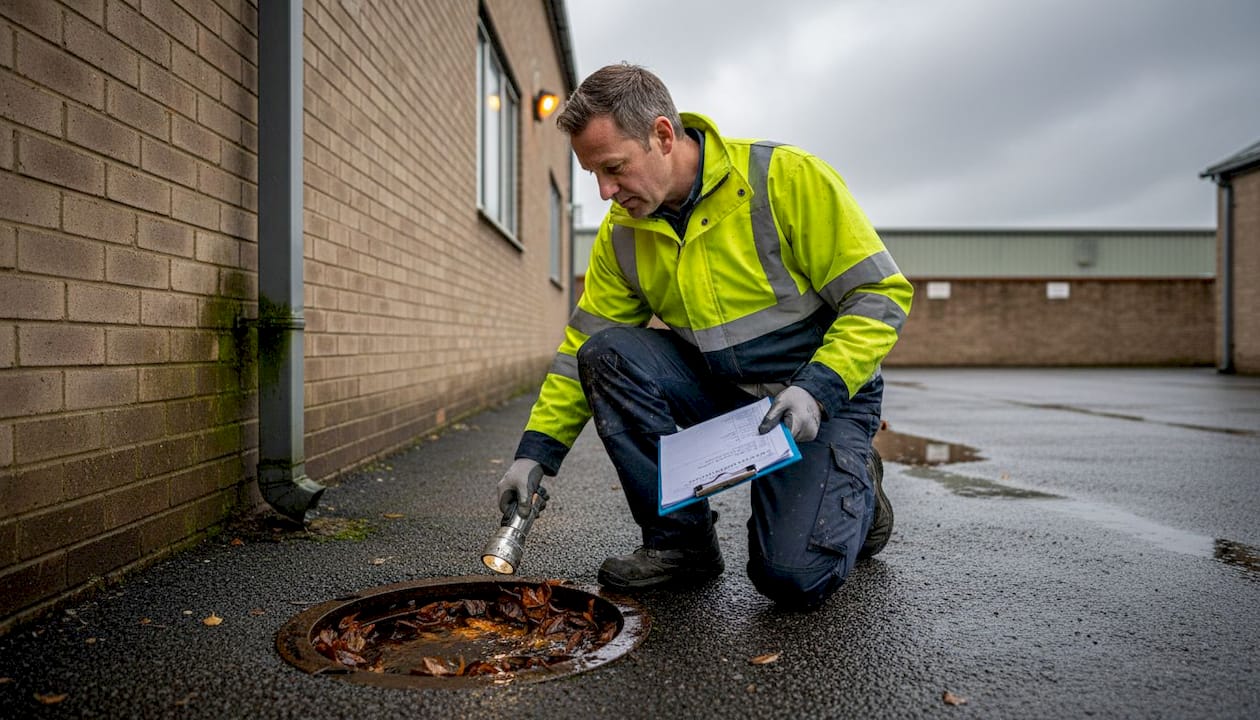
Routine PPM combining high-pressure jetting and CCTV inspection significantly reduces emergency callouts for commercial premises. Businesses that invest in drainage solutions for commercial buildings on a scheduled basis consistently report fewer disruptions than those who only act reactively.
For a broader understanding of how commercial systems differ from domestic ones, the commercial drainage guide covers the key distinctions in design, responsibility, and maintenance requirements.
Modern solutions: Maintenance strategies that prevent business disruption
Proactive measures and modern technology can keep your business running smoothly. The shift from reactive to planned maintenance is the single biggest change a business can make to its drainage management.
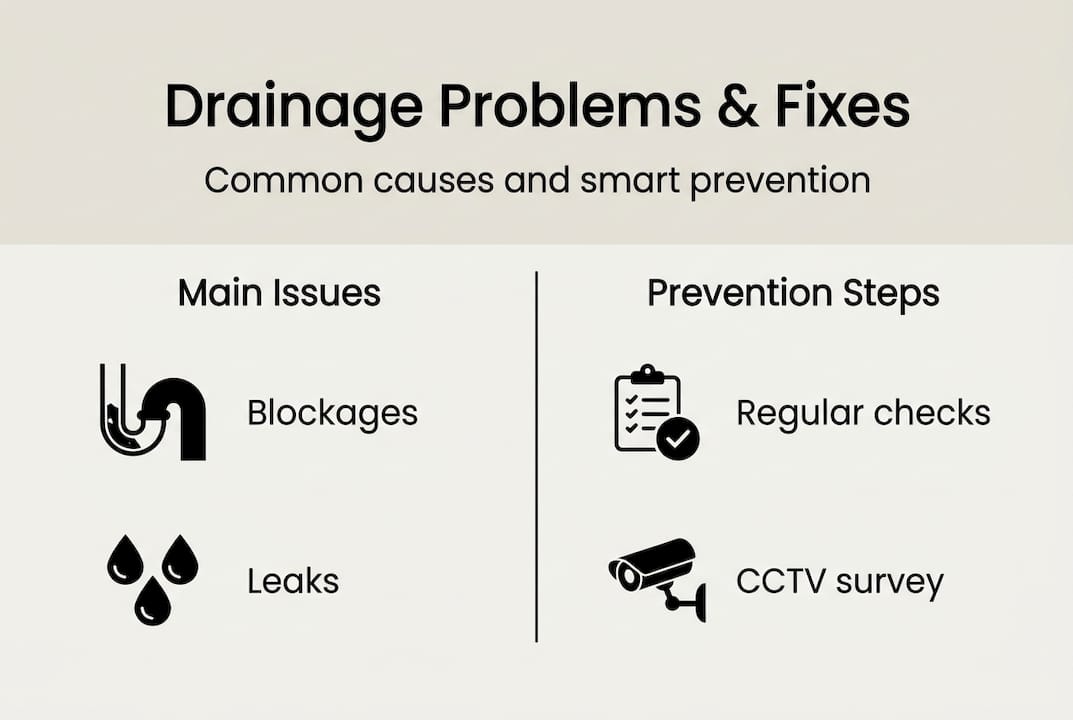
Planned preventative maintenance, known as PPM, involves scheduling regular inspections and cleaning before problems develop. It contrasts sharply with reactive repairs, which happen after a failure has already caused disruption. The cost difference is significant. Emergency callouts typically carry premium rates, and any associated property damage or business interruption adds further expense.
Quarterly servicing is recommended for high-use premises such as restaurants, while bi-annual servicing suits most other commercial properties.
| Service type | Frequency | Best suited for | Approximate benefit |
|---|---|---|---|
| High-pressure jetting | Quarterly | Restaurants, food businesses | Prevents grease build-up |
| CCTV inspection | Bi-annually | All commercial premises | Identifies hidden defects |
| Silt clearance | Annually | Car parks, industrial sites | Maintains flow capacity |
| Emergency callout | As needed | All premises | Reactive, higher cost |
Modern drainage technology has made inspections faster and less disruptive than ever. CCTV drain surveys use camera systems fed through the pipework to identify cracks, blockages, and root ingress without any excavation. No-dig relining techniques can then repair damaged sections from the inside, avoiding costly groundworks entirely.
Here is how to organise a PPM calendar for your business:
- Audit your drainage system. Identify all drain points, inspection chambers, and connection types across your premises.
- Classify your usage level. High-use kitchens need more frequent attention than office washrooms.
- Book a baseline CCTV survey. Understanding the current condition of your pipes gives you a starting point for scheduling.
- Set recurring service dates. Work with your drainage contractor to lock in quarterly or bi-annual visits in advance.
- Keep a maintenance log. Record every inspection, cleaning, and repair. This protects you legally and helps spot recurring issues.
Pro Tip: Ask your drainage contractor to provide a written condition report after each CCTV survey for drains. Over time, comparing reports reveals whether your system is stable or deteriorating, which helps you plan capital expenditure more accurately.
Understanding the importance of CCTV surveys goes beyond just spotting blockages. They provide documented evidence of your system’s condition, which can be invaluable during property transactions or insurance claims.
Reducing emergencies: Top tips for reliable business drainage
These strategies lay the groundwork, but what else can you do daily to prevent problems? The answer lies in building drainage awareness into your workplace culture, not just your maintenance schedule.
Staff behaviour is one of the most underrated factors in commercial drainage health. In hospitality settings, incorrect disposal of cooking oil, food scraps, and wet wipes accounts for a large proportion of blockages. In offices, paper towels flushed down toilets or cleaning products poured down sinks cause similar problems.
Here is a practical checklist for building drainage awareness across your team:
- Train new staff on correct waste disposal during induction.
- Post clear signage above kitchen sinks and in washrooms.
- Designate a staff member to carry out weekly drain checks.
- Keep a log of any reported symptoms, however minor.
- Store the contact details of your drainage contractor where all managers can access them.
- Know the location of your main drainage inspection chambers in case of emergency.
Planned PPM with regular jetting and CCTV inspection reduces both the frequency and cost of emergency repairs. Businesses that rely solely on reactive fixes consistently spend more over a three to five year period than those on a PPM contract.
If you spot a warning sign, act quickly. Do not wait to see whether it resolves itself. Slow drainage that persists for more than 48 hours is almost always a sign of a developing blockage. Odours that appear suddenly and do not clear with routine cleaning suggest a deeper problem in the pipework.
For businesses that want a clear framework, essential drainage solutions outlines the steps most relevant to UK commercial properties, including what to prioritise when budgets are tight.
Building a culture of drainage awareness does not require significant investment. It requires consistent communication, clear procedures, and a willingness to take small issues seriously before they become large ones.
A fresh perspective: Why ignoring drains costs more than you think
Here is something that rarely gets said plainly: most drainage emergencies we attend were entirely avoidable. Not because the business owner lacked resources, but because the early signs were dismissed as minor inconveniences.
Short-term cost-cutting on maintenance is a false economy. A single emergency callout can cost several times more than a year of scheduled servicing. Add in potential property damage, lost trading hours, and the cost of a health and safety inspection, and the financial case for prevention is overwhelming.
What we have found is that businesses with the fewest drainage problems are not necessarily those with the newest premises. They are the ones where managers take warning signs of drainage problems seriously from day one. They report issues early, they engage their staff, and they treat drainage maintenance as a normal operational cost rather than an optional extra.
The uncomfortable truth is that drainage only becomes a priority when it fails visibly. By then, the cost is always higher than it needed to be. Shifting that mindset, from reactive to genuinely proactive, is the most valuable change any property manager or business owner in the south of England can make.
Expert help: Keep your business protected with local drainage specialists
If this article has prompted you to take a closer look at your drainage system, the next step is straightforward. Getting a professional assessment of your current setup gives you the information you need to plan effectively and avoid costly surprises.
At Local Services Drainage, we work with businesses across the southern UK to deliver scheduled maintenance, emergency callouts, and full diagnostic surveys. Whether you need a CCTV drain survey to understand your current pipe condition or want to review your options following a recent issue, our team responds quickly and works around your operating hours. For businesses ready to move from reactive to planned maintenance, our commercial drain repair guide explains exactly what to expect from the process.
Frequently asked questions
How often should business drains be serviced?
Restaurants should service drains quarterly due to high grease output, while most other commercial premises benefit from bi-annual servicing as a minimum.
What are the warning signs of drainage problems in commercial buildings?
Odours, slow draining, gurgling noises, and localised flooding are the most reliable early indicators that your drainage system needs attention.
Does CCTV drain surveying prevent emergencies?
Routine CCTV inspections identify hidden defects and blockages before they escalate, reducing both the frequency and cost of emergency callouts significantly.
How can staff help avoid drainage issues?
Train staff to report slow drains immediately, follow correct waste disposal procedures, and keep drain covers clear of debris during daily cleaning routines.