TL;DR:
- Advanced sensors and AI now enable predictive detection of drainage issues before failures occur.
- Digital modelling tools improve the accuracy and speed of designing sustainable drainage systems like SuDS.
- Proper integration and ongoing expert oversight are essential for maximum benefit of smart drainage technologies.
Drainage problems rarely announce themselves before the damage is done. A slow blockage, hidden infiltration, or a crack forming deep underground can go unnoticed for months, quietly worsening until you’re facing flooded floors, structural subsidence, or a repair bill that makes you wince. For homeowners and property managers across southern UK, this uncertainty has long been frustrating. The good news is that the drainage industry has changed dramatically in recent years. Smart sensors, AI-driven analysis, digital design tools, and no-dig repair techniques are now reshaping how problems are found, fixed, and prevented altogether.
Table of Contents
- Understanding drainage challenges for UK homes and properties
- How smart sensors and AI-driven systems revolutionise detection
- Technology-enhanced drainage design: From SuDS to installation
- Case studies: Real-world benefits of advanced drainage solutions in southern UK
- What most homeowners and managers miss about drainage technology
- Take the next step with advanced drainage solutions
- Frequently asked questions
Key Takeaways
| Point | Details |
|---|---|
| Hidden risks revealed | Traditional drainage hides issues that technology now uncovers early, reducing costly damage. |
| Smarter, faster detection | Smart sensors and AI monitor blockages and infiltration in real time for swift intervention. |
| Design for the future | Digital tools optimise drainage system planning and compliance, ensuring lasting performance. |
| Proven results locally | Southern UK projects show fewer floods and failures thanks to technology-led drainage upgrades. |
| Expert support essential | Combining advanced solutions with professional oversight delivers the most reliable outcomes. |
Understanding drainage challenges for UK homes and properties
Most drainage failures don’t happen overnight. They develop gradually, driven by ageing infrastructure, ground movement, root intrusion, or the slow build-up of grease and debris inside pipes. In southern UK specifically, a mix of older Victorian-era pipework and rapid modern development creates a complicated picture. Properties that were built decades apart can share drainage connections, meaning a fault in one section can affect an entire street or terrace.
What makes this especially problematic is that many of the most damaging issues are completely invisible from the surface. Infiltration (the entry of groundwater into the drainage system through cracks and joints) is a prime example. Infiltration can account for up to 40% of domestic flow, creating hidden inefficiencies that strain the wider system without triggering any obvious warning signs at property level. You might not notice anything wrong until your drains start backing up during heavy rainfall, by which point the problem has likely been building for a long time.
Common drainage challenges that affect UK residential and managed properties include:
- Partial blockages from fat, grease, wet wipes, and silt that build up gradually
- Root ingress from trees and shrubs breaking through pipe joints
- Collapsed or displaced pipe sections caused by ground settlement
- Cracked pipework from thermal expansion and contraction over time
- Overloaded combined systems struggling to handle both surface water and foul flow
“Traditional CCTV surveys and reactive call-outs have long been the standard response to drainage issues, but they’re fundamentally retrospective. They identify problems that have already developed, rather than catching the conditions that lead to them.”
The challenge with older inspection methods is precisely this reactive nature. You discover the issue when something fails, not before. For property managers overseeing multiple sites, or homeowners with older pipework, diagnosing blocked drains before they become emergencies requires a different approach entirely.
How smart sensors and AI-driven systems revolutionise detection
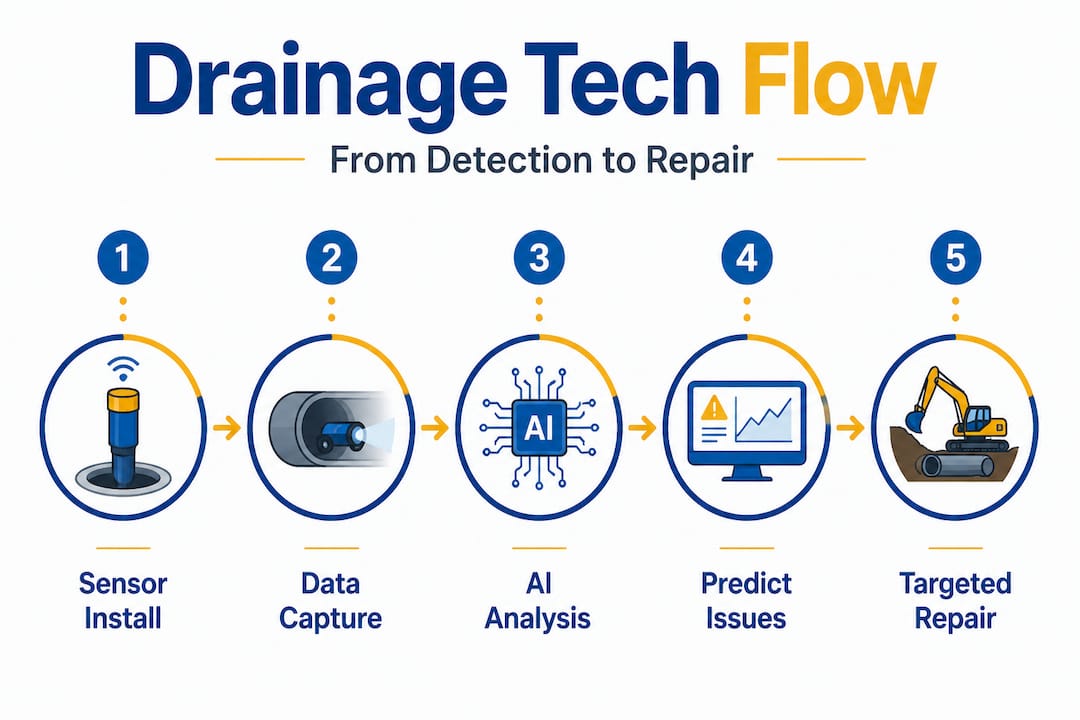
The shift from reactive to predictive drainage management is now being driven by technology that would have seemed far-fetched a decade ago. Smart sensors placed within or alongside drainage infrastructure can monitor conditions continuously, day and night, without any manual intervention required.
Smart sensors including acoustic, radar, flow, and level types enable real-time monitoring of infiltration, blockages, and overflows, with AI systems capable of analysing over 200 simultaneous data inputs to detect anomalies and cutting analysis costs by more than 50% compared with traditional manual methods. That’s not a marginal improvement. It’s a fundamental change in how drainage systems can be managed.
Here’s a plain-English breakdown of how these systems typically work:
- Acoustic sensors listen for the characteristic sounds of water movement changes, pipe vibrations, or air pockets that indicate developing blockages or leaks.
- Flow sensors measure the volume and speed of water moving through a section of pipe, flagging unusual drops or surges that suggest a problem upstream or downstream.
- Level sensors track water height within chambers and manholes, providing early warning of rising levels before an overflow occurs.
- Radar sensors can detect infiltration and structural irregularities within pipe walls without requiring physical access.
When all of these data streams feed into an AI analysis platform, the system builds a picture of what “normal” looks like for your specific drainage network. Any deviation triggers an alert, allowing intervention before a partial blockage becomes a full collapse or a slow infiltration point becomes a structural failure.
| Monitoring method | Frequency | Detection capability | Approximate cost saving |
|---|---|---|---|
| Manual CCTV survey | Annual or reactive | Visual defects only | Baseline |
| Flow and level sensors | Continuous | Flow anomalies, surges | 30 to 40% |
| Full AI sensor network | Continuous, real time | Infiltration, blockages, structural | 50%+ |
For tech-enabled drainage repairs, smart monitoring data also transforms the repair process itself. Engineers arrive on site already knowing the location, type, and likely severity of the problem. There’s no guesswork. No unnecessary excavation. The job is faster, cleaner, and considerably less disruptive to your property and your neighbours.
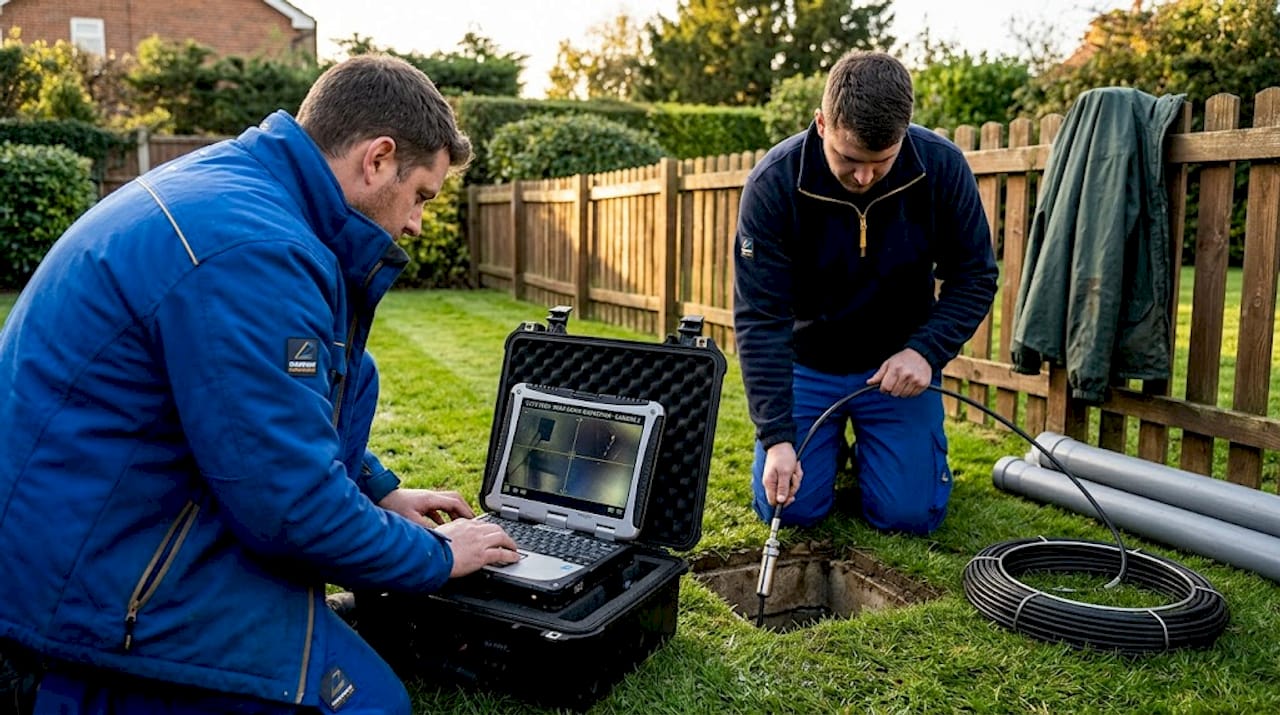
Pro Tip: If you manage multiple properties, ask your drainage contractor whether they can provide a sensor monitoring report before they recommend any repair work. A contractor using inspection technology should be able to show you data, not just describe what they found visually.
Technology-enhanced drainage design: From SuDS to installation
Smart monitoring is enormously valuable for existing systems. But what about new builds, extensions, or major drainage upgrades? This is where digital design tools are making an equally significant difference, shaping drainage infrastructure from the earliest planning stages rather than retrofitting solutions later.
Sustainable Drainage Systems (SuDS) are drainage approaches designed to manage surface water in ways that mimic natural water cycles. They include features like permeable paving, swales, retention ponds, and green roofs. Getting SuDS design right requires accurate modelling of catchment areas, soil permeability, rainfall intensity, and flow routing. Technology tools like InfoDrainage support SuDS design by handling these complex capacity challenges far more efficiently than traditional manual calculation methods ever could.
| Design approach | Time to model | Accuracy | Compliance confidence |
|---|---|---|---|
| Traditional manual calculation | Days to weeks | Moderate | Variable |
| Digital modelling software | Hours | High | Strong |
| AI-assisted design with live data | Near real time | Very high | Excellent |
When designing or upgrading surface water drainage for your property, a technology-led approach brings several important advantages over traditional methods. Key considerations when adopting this kind of approach include:
- Ensuring your contractor uses validated modelling software rather than rule-of-thumb sizing
- Checking that design outputs are compared against current UK drainage standards and local authority requirements
- Confirming that the installed system matches the modelled design, not just a rough approximation of it
- Planning for monitoring integration from the outset so sensors can be installed during construction rather than retrofitted later
- Requesting documentation of the design model so future contractors or surveyors can reference it accurately
The most common misstep in technology-driven drainage projects is assuming that the software does all the work. Digital tools are only as reliable as the data fed into them and the expertise of the engineer interpreting the outputs. A poorly configured model can produce confident-looking results that are completely wrong. This is why expert oversight, during both the design and tech-assisted installation phases, remains critical regardless of how sophisticated the software is.
Pro Tip: When reviewing quotes for new drainage installations, ask specifically whether the design was modelled using software or estimated manually. If it was modelled, request a summary of the assumptions used. This one question tells you a great deal about the professionalism of the contractor you’re dealing with.
Understanding the different drainage system types available is also essential before committing to any design approach, since the technology used needs to match the physical system being built or maintained.
Case studies: Real-world benefits of advanced drainage solutions in southern UK
The technology described above isn’t theoretical. UK water companies and private contractors have been running trials and live deployments for several years, producing measurable results that are directly relevant for southern UK property owners.
Trials by UK water companies including Northumbrian Water, United Utilities, and Anglian Water validate that smart technology reduces spills and floods, with southern UK pilot projects demonstrating strong applicability in similar infrastructure conditions. The lessons from these programmes are being adopted by drainage contractors serving residential and commercial clients across Hampshire, Surrey, Kent, and neighbouring counties.
Here are the key outcomes that emerge consistently across these real-world deployments:
- Faster fault identification: Monitoring systems detect developing faults days or weeks before they would become apparent through visual inspection or customer reports.
- Reduced emergency call-outs: Properties using continuous monitoring see significantly fewer sudden failures because problems are addressed during the early, manageable stage.
- Longer system lifespan: Early intervention means repairs are smaller in scope, preserving the structural integrity of the wider pipe network rather than waiting for a section to fail completely.
- Lower lifetime costs: While sensor installation has an upfront cost, the reduction in emergency repair fees, property damage, and reactive maintenance creates clear savings over three to five years.
Smart monitoring in southern UK pilot projects has shown that identifying infiltration early can reduce associated repair costs by a substantial margin, simply because the intervention required at an early stage is far less invasive than addressing a fully developed failure.
For those considering upgrading with advanced drainage technology, the evidence from these trials is encouraging. The technology is proven, the cost structure is improving as it becomes more mainstream, and the operational model is now well-understood by reputable drainage contractors in the region.
It’s also worth noting how much these technologies improve the value of regular drainage inspections. When continuous sensor data is combined with periodic expert inspections, you get a complete picture of system health, not just a snapshot taken on one day each year.
What most homeowners and managers miss about drainage technology
Here’s a view that doesn’t get enough attention in conversations about drainage technology: the biggest risk isn’t failing to adopt smart systems. It’s adopting them without understanding what they actually require from you in return.
There’s a growing tendency for property managers and homeowners to see smart drainage sensors as a set-and-forget solution. You install the kit, receive alerts on your phone, and assume everything is taken care of. In practice, alerts without action are useless, and data without interpretation is just noise. The technology creates information. It’s still up to you and your contractor to act on it correctly.
DIY technology adoption is a particular concern. There are consumer-level sensors and basic flow monitors available, but without the analytical framework and engineering expertise to contextualise the readings, misdiagnosis is common. You might receive an alert about elevated water levels and assume you have a blockage, when the real issue is a failing joint that requires a completely different repair approach. Acting on a misread alert can mean unnecessary expense and the wrong repair being carried out.
The properties that gain the most from drainage technology are those with maintenance contracts in place, where a drainage professional is regularly reviewing the monitoring data, adjusting alert thresholds as seasons change, and scheduling preventive maintenance based on what the data actually shows. This is predictive management rather than reactive panic, and it’s a fundamentally different relationship with your drainage infrastructure.
The contrarian point worth making is this: the quality of your initial installation matters less than you might think if the ongoing monitoring and maintenance regime is weak. A perfectly designed and installed SuDS system with no monitoring can perform worse over ten years than a more modest system with rigorous ongoing oversight. Consistent, expert attention is what sustains long-term performance.
For those wanting to align their approach with industry standards, reviewing best practices for drainage tech is a practical starting point for understanding what a proper maintenance programme should look like.
Take the next step with advanced drainage solutions
If you’ve recognised your own situation somewhere in this article, whether it’s unexplained slow drains, concerns about an ageing pipe network, or a managed property where reactive call-outs are becoming too frequent, the next step is straightforward. The technology exists. The expertise is available. You simply need the right team to bring them together for your specific property and circumstances.
At Local Services Drainage, we specialise in reliable tech-driven repairs across the southern UK, using the same sensor technology and diagnostic methods described throughout this article. Our CCTV drain surveys give you a definitive picture of your system’s condition, while our repair and monitoring services ensure that problems are addressed properly the first time. Whether you’re a homeowner dealing with a persistent issue or a property manager looking to move from reactive to preventive drainage management, our team is ready to help. Explore our expert drain repair practices or contact us today to discuss a tailored solution for your property.
Frequently asked questions
What types of smart sensors are used in UK drainage systems?
Acoustic, radar, flow, and level sensors are the primary types used in UK drainage, each monitoring different aspects such as infiltration levels, blockage development, and overflow risk in real time.
How does artificial intelligence improve drainage system maintenance?
AI analyses data from multiple sensors simultaneously, with systems capable of processing over 200 inputs to identify anomalies far faster and more accurately than manual monitoring, reducing both errors and overall analysis costs by more than 50%.
Are smart drainage solutions suitable for older properties?
Yes, smart sensors and AI monitoring can be retrofitted to most existing drainage systems, making them just as relevant for Victorian-era pipework as for modern installations, provided the right sensor type is selected for the pipe configuration.
What is the main advantage of using SuDS technology tools during design?
Digital tools like InfoDrainage allow engineers to model complex drainage scenarios with accuracy and speed that manual methods cannot match, significantly reducing the risk of capacity failures and ensuring designs meet current UK standards from the outset.
Do monitored drainage systems require specialist maintenance?
Yes, ongoing expert oversight is essential. Sensor data needs to be interpreted by qualified drainage professionals who can adjust thresholds, schedule preventive work, and ensure the system continues to operate as intended rather than simply generating unreviewed alerts.
Recommended
- Advanced drainage technology for reliable UK repairs
- Best Guide About CCTV Drain Surveys in 2024
- Drainage inspection guide: diagnose and maintain your home
- Comprehensive CCTV Drain Inspection Services in 2024
- Sewer Repair Technology: No-Dig Solutions | Trenchless Maine
- How Trenchless Repair Cuts Sewer Project Time Fast