TL;DR:
- Poor drainage poses significant financial and structural risks to UK commercial properties.
- Regular preventative maintenance and compliance with regulations like BS 8490:2025 reduce costs and legal liabilities.
- Proactive drainage strategies, including CCTV surveys and SuDS adoption, enhance resilience and tenant satisfaction.
Poor drainage is one of the most underestimated financial risks facing commercial property owners in the UK. Many managers assume a slow drain or occasional puddle is a minor nuisance, yet 37.5% of blockages in commercial properties stem from fats, oils, and grease alone. Water damage, tenant disputes, and invalidated insurance policies are the real consequences of neglect. This article covers why drainage matters, what threatens your system, what the law requires, and how to move from reactive panic to planned resilience. Whether you manage a single commercial unit or a large multi-tenant complex, what follows will help you make smarter, better-informed decisions.
Table of Contents
- Why drainage matters for commercial properties
- Common drainage threats and risks in UK commercial buildings
- Key UK regulations and standards for commercial drainage
- Proactive vs reactive drainage maintenance: costs and benefits
- Why most commercial drainage strategies miss the mark
- Find expert drainage support for your property
- Frequently asked questions
Key Takeaways
| Point | Details |
|---|---|
| Drainage prevents costly damage | Effective drainage stops water damage, tenant complaints, and business interruptions. |
| Compliance is essential | Neglecting new UK drainage standards may invalidate insurance and risk legal penalties. |
| Planned maintenance saves money | Regular inspections and contracts cost less than emergency blockage and repair costs. |
| Region-specific risks matter | Unique threats like clay soils and shared systems demand tailored drainage strategies. |
| Proactive action ensures resilience | Early detection and prevention with CCTV or SuDS secures property value and compliance. |
Why drainage matters for commercial properties
Effective drainage is not simply about keeping water moving. It is the foundation that protects your building’s structure, satisfies your tenants, and keeps your insurance valid. When drainage fails, the consequences spread quickly across every part of your operation.
Consider what a single blocked drain can trigger: flooded car parks, contaminated communal areas, halted business operations, and formal complaints from tenants. These are not rare edge cases. Neglected drainage accounts for 25% of building damage across UK commercial stock, and insurers are increasingly scrutinising maintenance records before honouring claims.
Here is why drainage deserves a place at the top of your property management agenda:
- Structural protection: Water ingress from failed drains erodes foundations, weakens walls, and causes subsidence over time.
- Tenant retention: Persistent drainage problems are among the top reasons commercial tenants seek early lease exits.
- Insurance validity: Many policies include clauses requiring evidence of regular maintenance. Without it, a claim can be rejected outright.
- Legal liability: If a blocked drain causes injury or damage to a third party, you could face significant legal costs.
- Regulatory compliance: Maintaining commercial drainage to the required standard is now more demanding than ever, particularly with the introduction of BS 8490:2025.
“The cost of a planned maintenance contract is almost always a fraction of what you will spend recovering from a single major drainage failure.”
The new BS 8490:2025 standard has raised the bar for internal gutter drainage systems, requiring secondary siphonic drainage and documented maintenance schedules. For many older commercial buildings, this means upgrades are no longer optional. Investing in reliable drainage solutions now is far cheaper than retrofitting systems under pressure after a failure or inspection.
The financial argument is straightforward. Routine upkeep costs are predictable and manageable. Emergency repairs, legal fees, insurance disputes, and lost rental income are not. Drainage maintenance is not an overhead to minimise. It is a risk management tool.
Common drainage threats and risks in UK commercial buildings
Knowing what threatens your drainage system is the first step to protecting it. UK commercial buildings face a specific set of risks, and some are more common than most property managers expect.
The two biggest culprits are well documented. FOG causes 37.5% of commercial blockages, while inappropriate items flushed down toilets or drains account for a further 33.3%. Together, these two causes are responsible for more than seven in ten blockages across the sector. For properties with food service tenants, restaurants, or staff canteens, the FOG risk is especially acute.
Beyond FOG and inappropriate items, commercial buildings face several other significant threats:
- Tree root ingress: Roots seek moisture and can crack or collapse older clay pipes, which are still common in many southern UK properties.
- Structural deterioration: Ageing pipework, ground movement, and historic repairs can create weak points that fail without warning.
- Shared drainage systems: Multi-tenant buildings often share drainage infrastructure. One tenant’s poor habits can block a system that affects everyone.
- Surface water overload: Heavy rainfall overwhelms systems not designed for current climate patterns, particularly in areas with clay-heavy soils.
| Threat | Primary cause | Risk level for multi-tenant buildings |
|---|---|---|
| FOG blockages | Food service tenants | High |
| Inappropriate items | Staff/visitor misuse | Medium to high |
| Tree root ingress | Ageing clay pipes | Medium |
| Structural failure | Age and ground movement | Medium to high |
| Surface water overload | Clay soils, heavy rain | High in southern UK |
Clay soils, which are widespread across southern England, are particularly problematic. They shift significantly with seasonal moisture changes, placing stress on buried pipework and accelerating joint failures. Properties in these areas should factor in more frequent inspections as standard practice. You can also explore efficient drainage solutions specifically designed for commercial buildings to address these regional challenges.
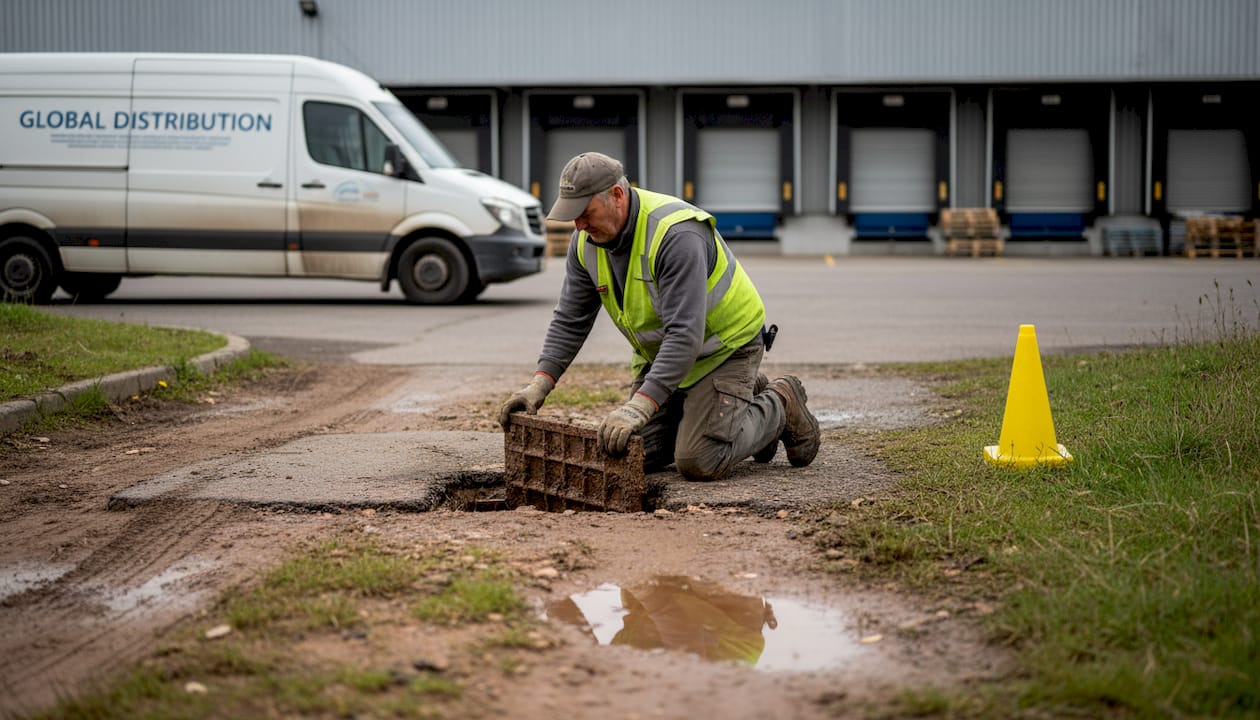
For properties dealing with persistent waterlogging or unexplained slow drains, understanding drainage issues in southern UK can help you identify whether your system needs targeted intervention. External factors such as filtration and leak fixes in adjacent structures can also contribute to drainage stress in shared or terraced commercial premises.
Pro Tip: If you manage a building with multiple food service tenants, consider installing grease traps and scheduling quarterly drain jetting. This single measure can dramatically reduce your FOG-related call-outs.
Key UK regulations and standards for commercial drainage
Regulations around commercial drainage have become considerably more demanding in recent years. Understanding what applies to your property is not optional. It is a legal and financial necessity.
The most significant recent development is BS 8490:2025, which mandates secondary siphonic drainage systems for internal gutters and requires documented maintenance programmes. Non-compliance does not just risk a fine. It can invalidate your building insurance entirely, leaving you exposed to enormous uninsured losses.
Alongside BS 8490:2025, the government’s preferred approach to surface water management is now sustainable urban drainage (SuDS). Local councils are increasingly requiring SuDS compliance for new developments and major refurbishments. SuDS systems manage rainfall at source, reducing runoff and flood risk rather than simply channelling water away.
Here is a practical compliance checklist for commercial property owners in 2026:
- Audit your internal gutters to confirm whether secondary siphonic drainage is installed and functioning.
- Review your maintenance records to ensure you can demonstrate a documented schedule of inspections and servicing.
- Check your insurance policy for drainage maintenance clauses and confirm you are meeting the stated requirements.
- Assess surface water management on your site and establish whether SuDS measures are required or recommended.
- Consult a qualified drainage engineer if your building is older or has undergone significant alterations.
| Regulation or standard | What it requires | Who is affected |
|---|---|---|
| BS 8490:2025 | Secondary siphonic systems, maintenance records | Commercial buildings with internal gutters |
| SuDS national standards | Surface water managed at source | New builds, major refurbishments |
| Building insurance clauses | Evidence of regular maintenance | All commercial property owners |
For a clear breakdown of what these standards mean in practice, UK drainage standards explained is a useful starting point. If you are unsure how the rules apply to your specific building type, guidance on drainage for UK businesses can help clarify your obligations.
Proactive vs reactive drainage maintenance: costs and benefits
The maintenance approach you choose will define both your costs and your exposure to risk. The difference between planned and reactive maintenance is not just financial. It is the difference between control and crisis.
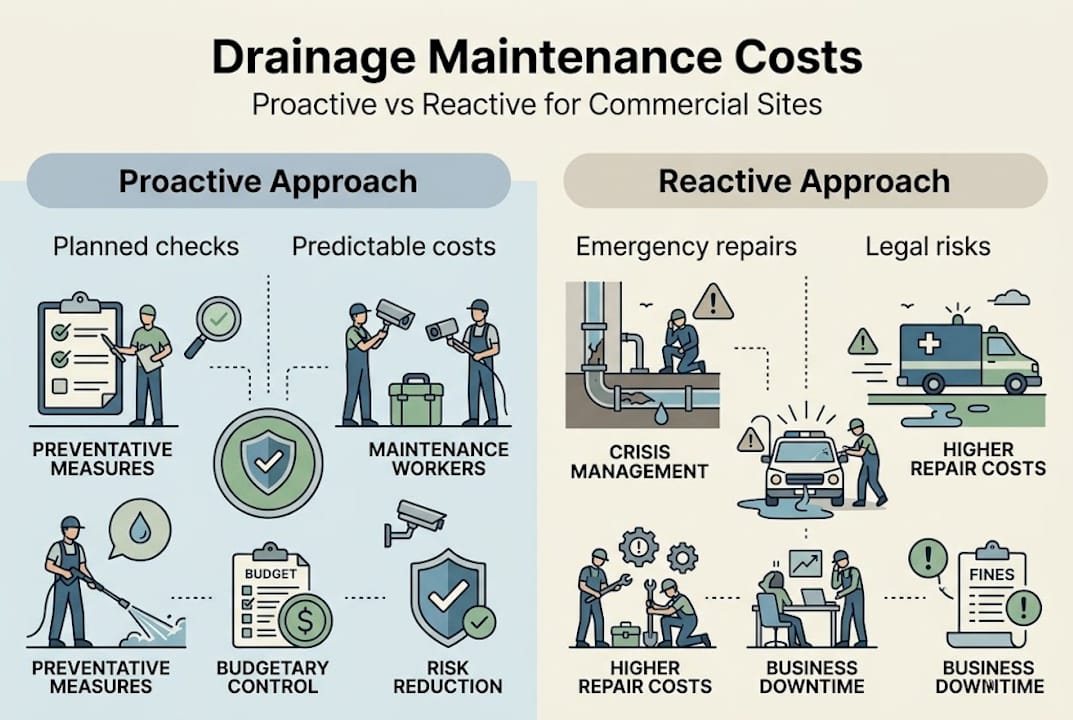
Planned preventative maintenance (PPM) contracts typically cost between £400 and £5,000 per year depending on the size and complexity of your drainage system. Emergency call-outs, by contrast, can reach £15,000 or more for a single incident, and that figure does not include consequential losses such as business interruption, tenant compensation, or structural repairs.
The case for proactive maintenance is not just about avoiding emergencies. Regular CCTV surveys have been shown to cut tenant complaints by 80% in commercial complexes. That is a measurable improvement in tenant satisfaction and retention, which directly supports rental income stability.
A well-structured proactive maintenance programme typically includes:
- Annual CCTV drain surveys to identify developing problems before they become failures.
- Quarterly or bi-annual drain jetting for high-use or high-risk systems.
- Grease trap servicing for any property with food preparation areas.
- Written maintenance logs that satisfy insurance requirements and demonstrate due diligence.
- Rapid response protocols so that when something does go wrong, you have a plan and a contractor ready.
Pro Tip: Schedule your annual CCTV survey in autumn, before winter rainfall peaks. This gives you time to address any issues found before the highest-risk season for blockages and flooding.
For properties in flood-prone areas, drainage maintenance to prevent floods is an essential read. Practical drainage tips for southern UK properties can also help you tailor your schedule to regional conditions. When repairs are needed, following expert drainage repair tips ensures work is done to a standard that holds.
Why most commercial drainage strategies miss the mark
After years of working with commercial property managers across the UK, we have noticed a consistent pattern. Most drainage strategies are not really strategies at all. They are a list of contractors to call when something goes wrong.
The problem with reactive-only thinking is that it always costs more than you expect, and it compounds over time. A small crack in a clay pipe that a CCTV survey would catch for a few hundred pounds becomes a collapsed section requiring excavation and reinstatement costing thousands. The hidden cost of neglect is always higher than the visible cost of prevention.
What genuinely resilient drainage looks like is different from what most managers assume. It is not just about fixing problems faster. It is about understanding your building’s specific vulnerabilities, the local soil conditions, the age of your pipework, and the behaviour of your tenants. Better drainage planning starts with a proper survey, not a call-out.
SuDS and CCTV technology are two tools that remain chronically underused in older commercial stock. Both are cost-effective, both are increasingly required by regulation, and both deliver measurable returns. The managers who adopt them early will face fewer crises, lower long-term costs, and stronger insurance positions than those who continue to wait for something to break.
Find expert drainage support for your property
Moving from reactive repairs to planned resilience is a practical step, not an aspirational one. The right professional support makes the difference between a drainage system that quietly protects your property and one that repeatedly disrupts your tenants and your budget.
At Local Services Drainage, we work with commercial property owners and managers across southern UK to deliver exactly that. From drain unblocking explained to full CCTV drain surveys that identify problems before they escalate, our team brings the technology and expertise your property needs. If you are ready to address drainage issue solutions specific to your building, get in touch today to arrange a survey or discuss a planned maintenance contract that fits your budget and compliance requirements.
Frequently asked questions
What are the main causes of commercial drain blockages in the UK?
FOG causes 37.5% of blockages and inappropriate items a further 33.3%, meaning these two factors alone account for over 70% of commercial drain failures. Addressing both through staff training and grease trap installation significantly reduces call-out frequency.
What is BS 8490:2025 and how does it affect my commercial property?
BS 8490:2025 requires secondary siphonic drainage systems for internal gutters and documented maintenance schedules. Failing to comply can invalidate your building insurance and expose you to uninsured losses.
How much does professional drainage maintenance cost?
PPM contracts cost between £400 and £5,000 annually depending on system size, while a single emergency repair can reach £15,000 or more, making planned maintenance the clear financial choice.
Why are SuDS important for commercial buildings?
SuDS are government-preferred for managing surface water because they reduce runoff and flooding risk at source rather than simply redirecting water into already strained public sewers.
How often should commercial drains be inspected?
Most drainage professionals recommend at least one full CCTV survey per year, with higher-risk systems such as those serving food preparation areas or older clay pipework inspected more frequently.